• Skip to primary navigation
  • Skip to main content
  • Skip to primary sidebar
Notes From the Parsonage
  • About Us
    • Privacy Policy
  • Faith
    • Encouragement
    • Bible Reviews
    • Seasonal Devotionals
    • Topical Devotionals
  • Family
    • Kid Product Reviews
    • Mama
    • Crafts
  • Homeschool
    • Morning Basket
    • Bible Classes
  • Table
    • Kitchen Product Reviews
    • Recipes
      • Desserts
      • Large Family Meals

Easiest Necktie Ever

March 1, 2024 by notesfromtheparsonage 4 Comments


My boys love neckties. They get it from their dad. We’re talking real neckties. They very much dislike clip on neckties. They seem offended by them. They get that from their dad, too. I have made quite a few neckties for my boys and finally found the absolute easiest way to make a real necktie.

NT Main Image FIXED


Grab your supplies. You’ll need about 1/3 of a yard of two fabrics. I like contrasting ones. One will be on the inside and will only peek out a tiny bit, so it can be anything, really. 
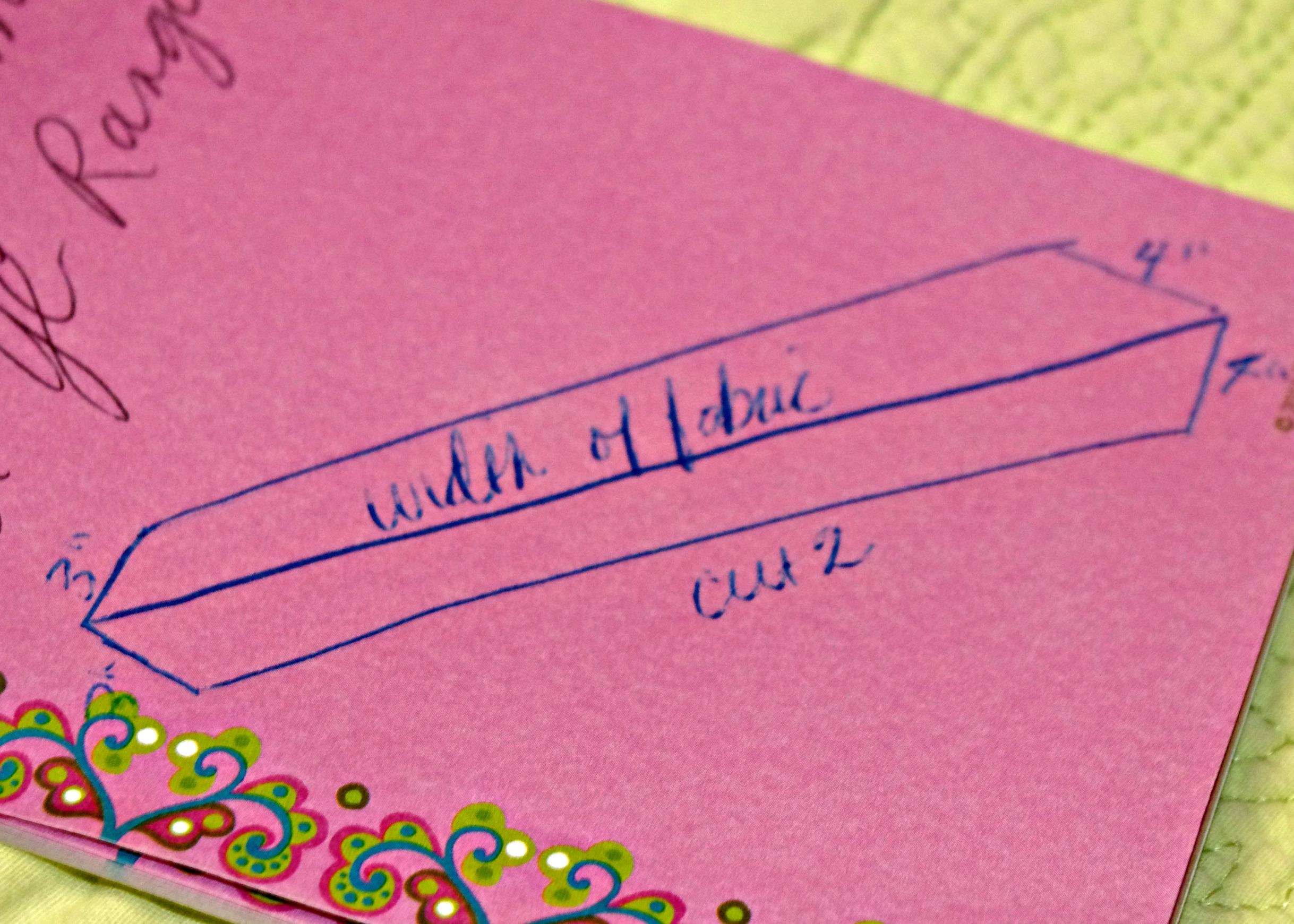
NT pattern paper

Essentially, this is what you’re doing. You’re going to use a yard stick to make a straight line across the width of your fabric. Then you’ll draw in your points, connect the dots, sew, flip, sew, flip, and you’ll have a tie. Super easy. After you make the first one, you’ll see. 

NT Pattern End 4

Place your contrast fabric right side up on you cutting surface (ironing board, floor, whatever you use). Place your main fabric right side down, lining it up with the contrast fabric. (If you’re using a dark pen or marker on light fabric, you may want to put the main fabric on bottom and the contrast on top so you won’t see the marks through your fabric. It really doesn’t matter as long as you know what you want to be the main fabric.)

Using a yard stick (or whatever straight edge you’ve got), draw a line from one side of the fabric to the other. If you’re making this for a toddler, 36″ in long enough. For a bigger boy, you’ll want to use as much width as you can. (Also, check out the variation at the end of this tutorial for making older boy and man neckties using this same method!)
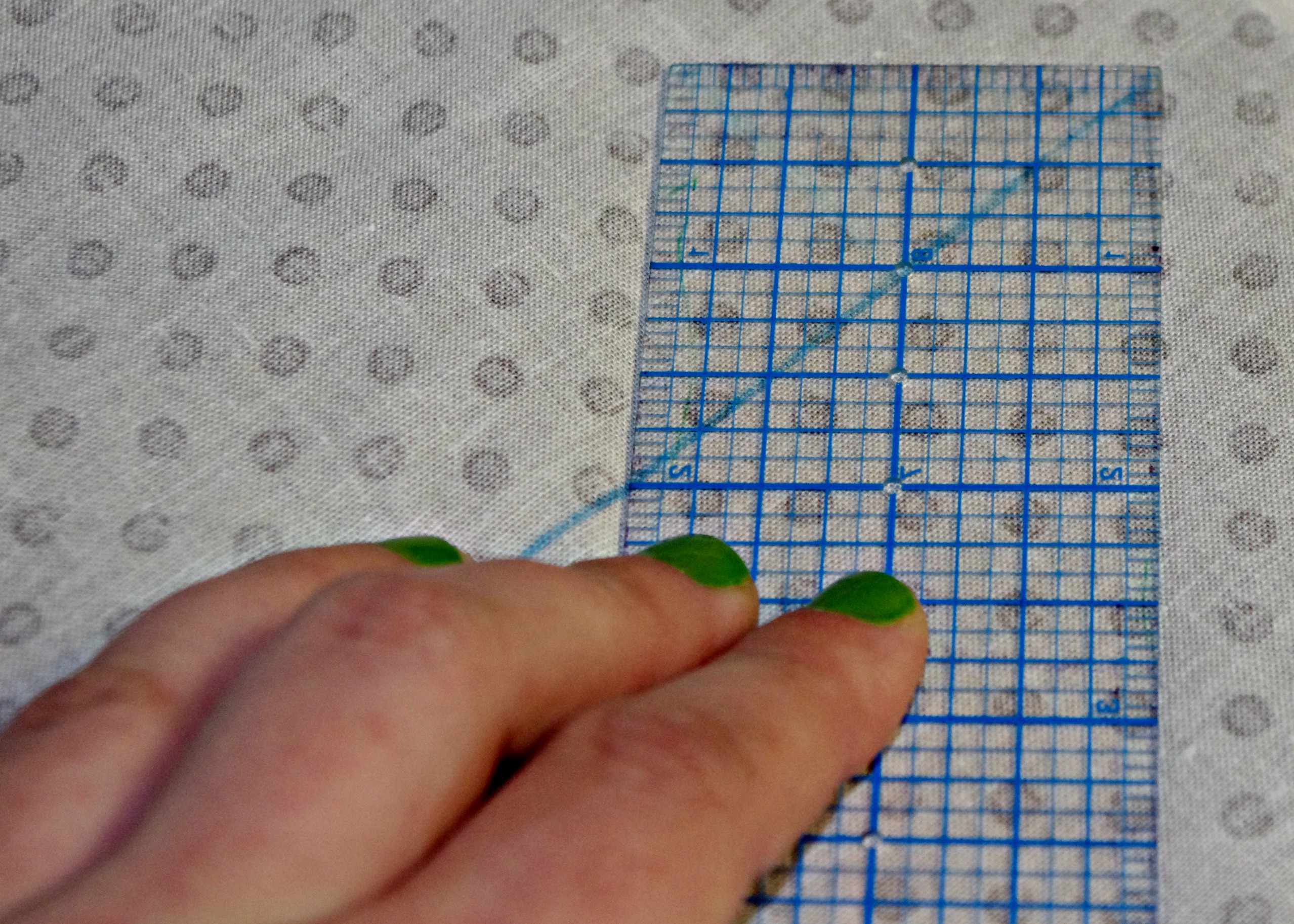
NT pattern end

Using a quilting ruler, line up your ruler so you’ve got a right angle going on at the tip. (See the photo.) Make a line 4″ long from the center. 

NT pattern end 2

Using your quilting ruler, line up the other side. You want the tip of the tie to be a 90 degree angle. (See photo for help lining it up.) Mark 4″ in that direction. 

NT Pattern End 3

At the other end of the line across your fabric (also known as the other end of your tie), do the same thing, only mark that side 3″ from the center line. Make sure the tip is a 90 degree angle. 

NT Pattern End 4

Use your yard stick to connect the ends of your 4″ line to your 3″ line. This is the side of the tie. It should look something like the picture.


(You can tweak the measurements if you want a fatter or more narrow tie. I do 4.5″ for an adult tie. 3.5″ for a toddler tie. Just don’t make the small end smaller that 2″ or you’ll be kicking yourself when you try to turn it.)
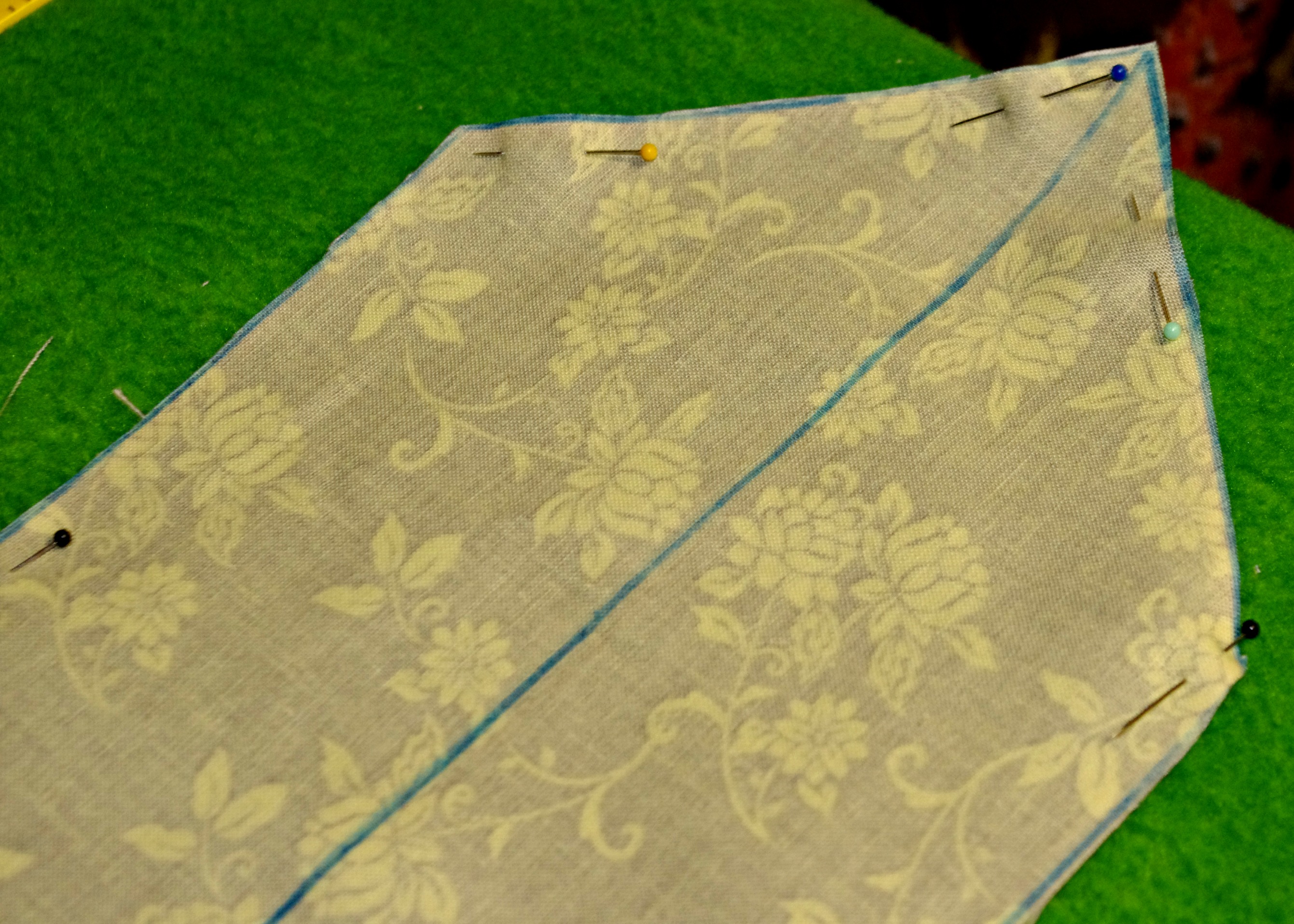
NT Pin

Pin your two layers of fabric together around the drawn on pattern. (Believe me, this makes your life a little easier here in a minute.) Cut out both layers of fabric together. 
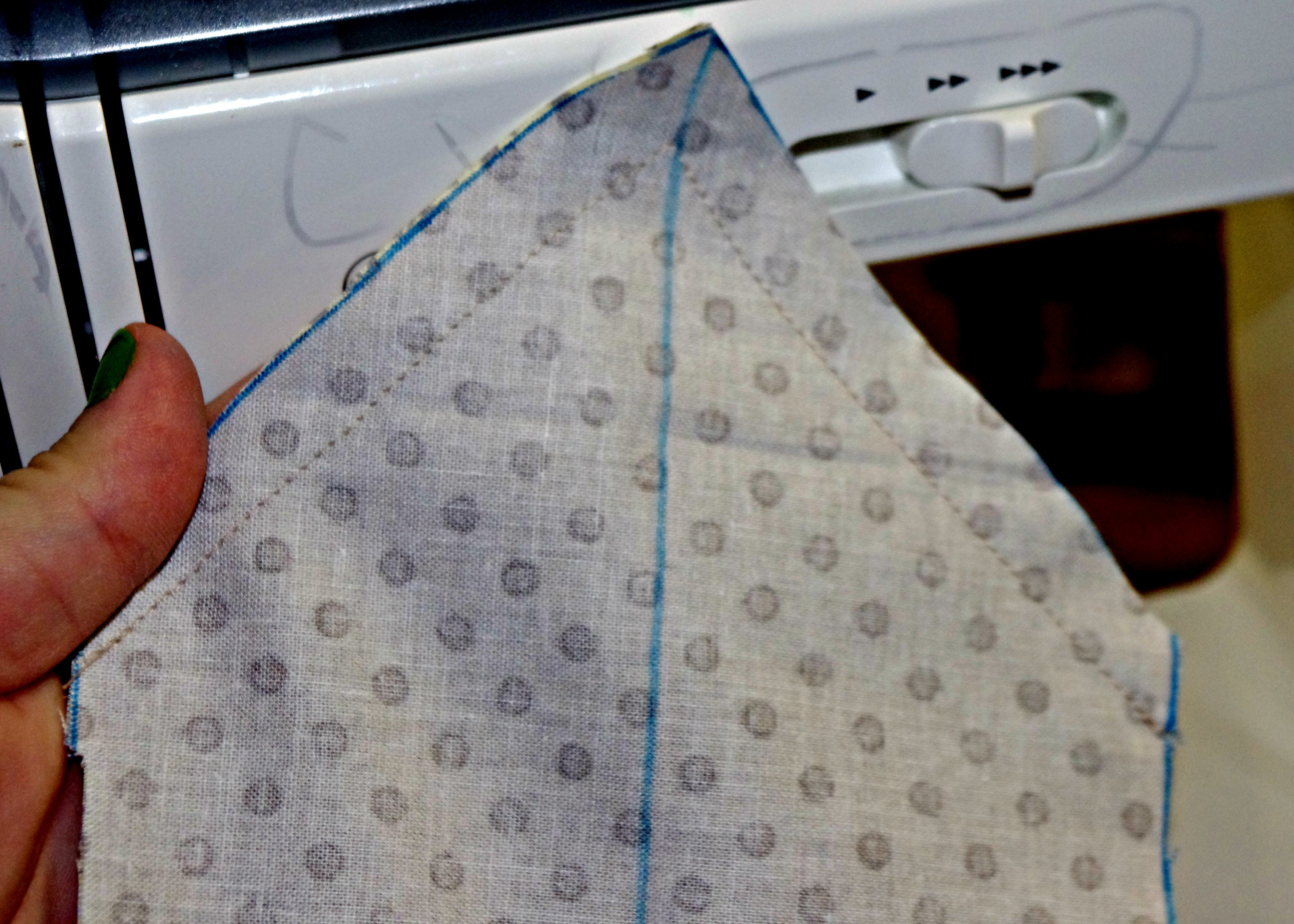
NT Sew end

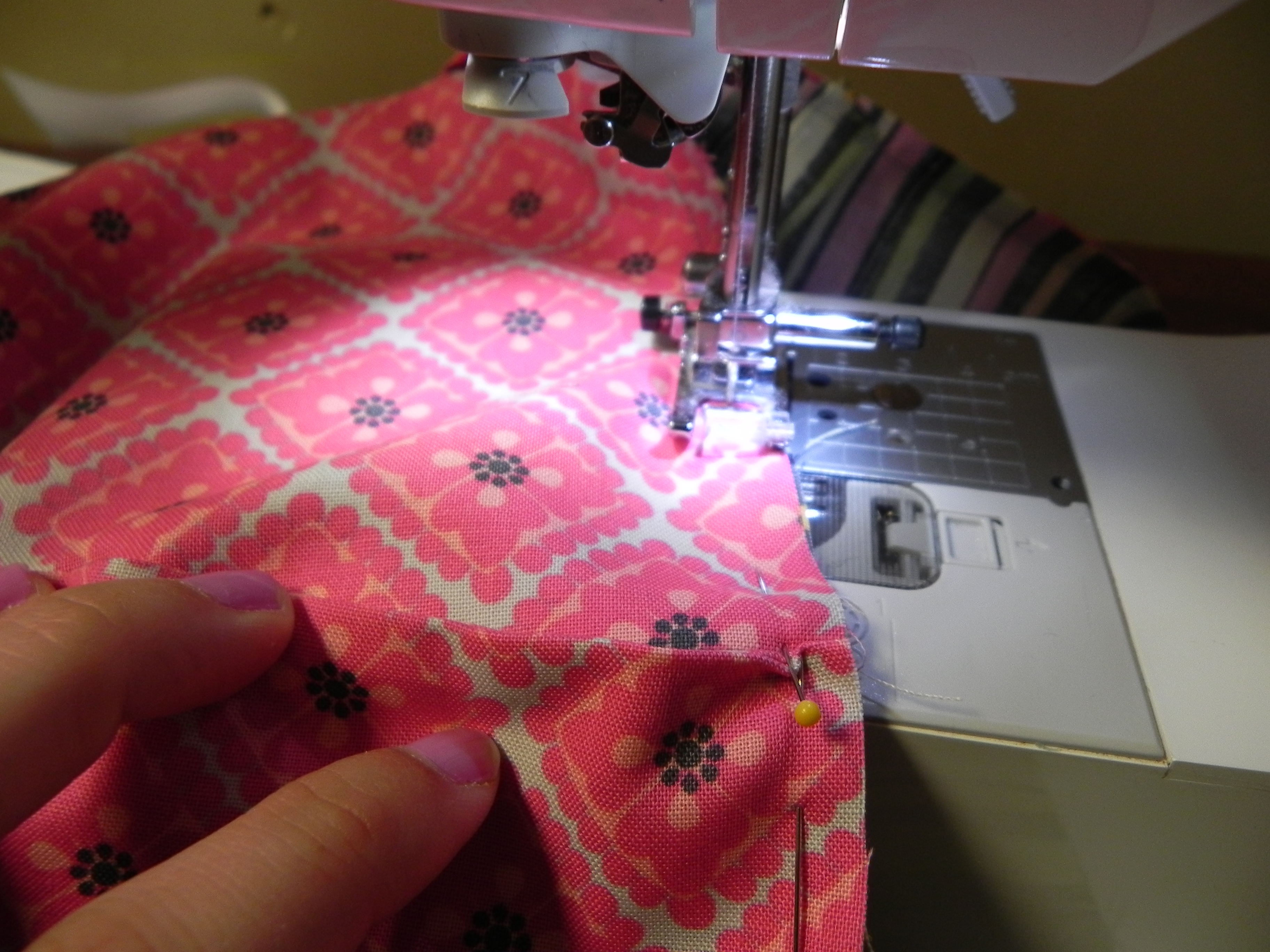
You’ve already got the right sides of the fabric together. It is already pinned. You’re ready to sew! Sew the end of the tie. Just the end. (Do not sew the sides yet. It only seems weird the first time.)
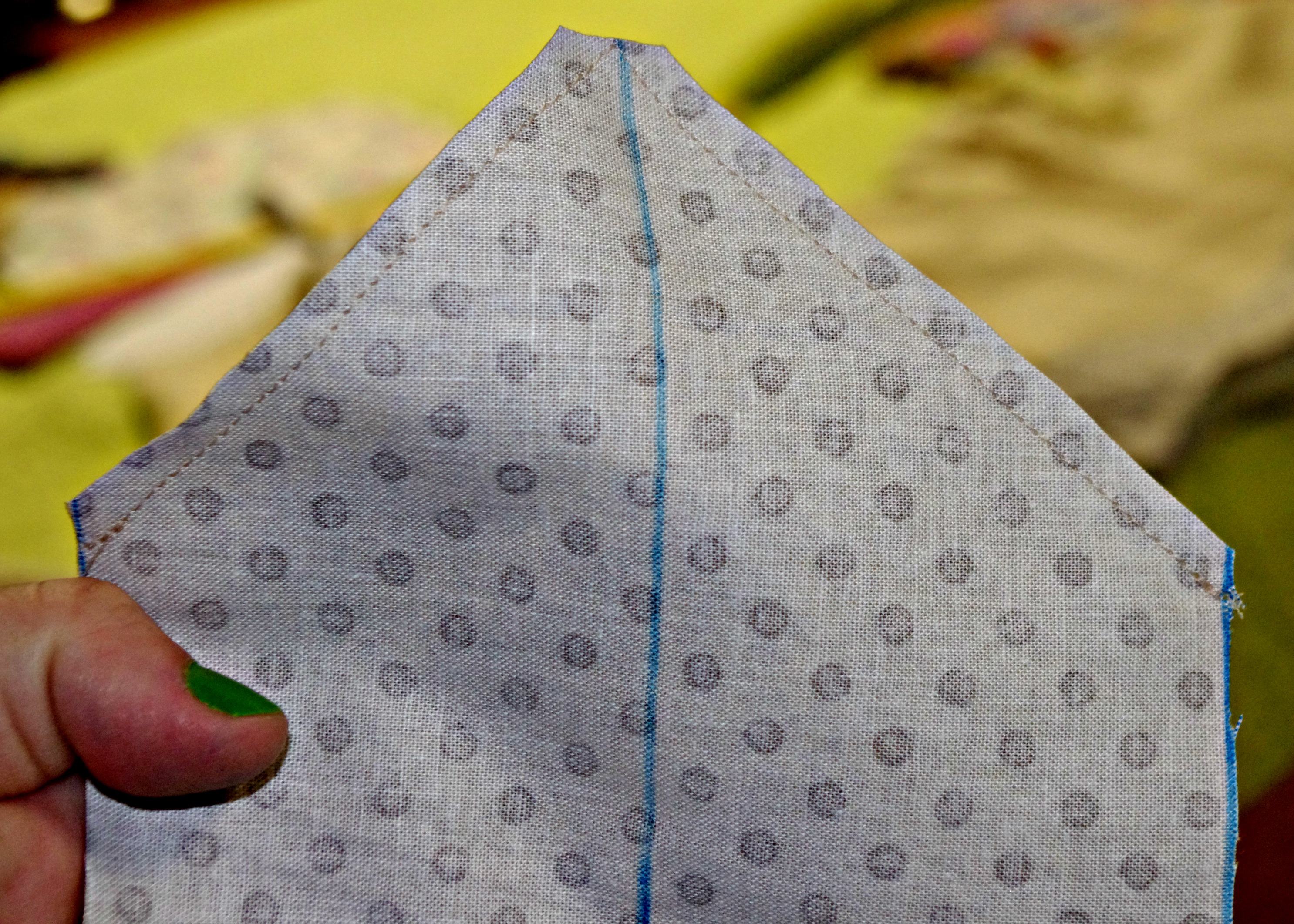
NT trim end

Clip the edges.


Repeat for the other end of the tie. Once again, just the end! Not the sides. 

NT press end

Turn your tie right side out, pushing out the points. Press. The sides are still unfinished at this point. You’ve only sewn the two end points together. 
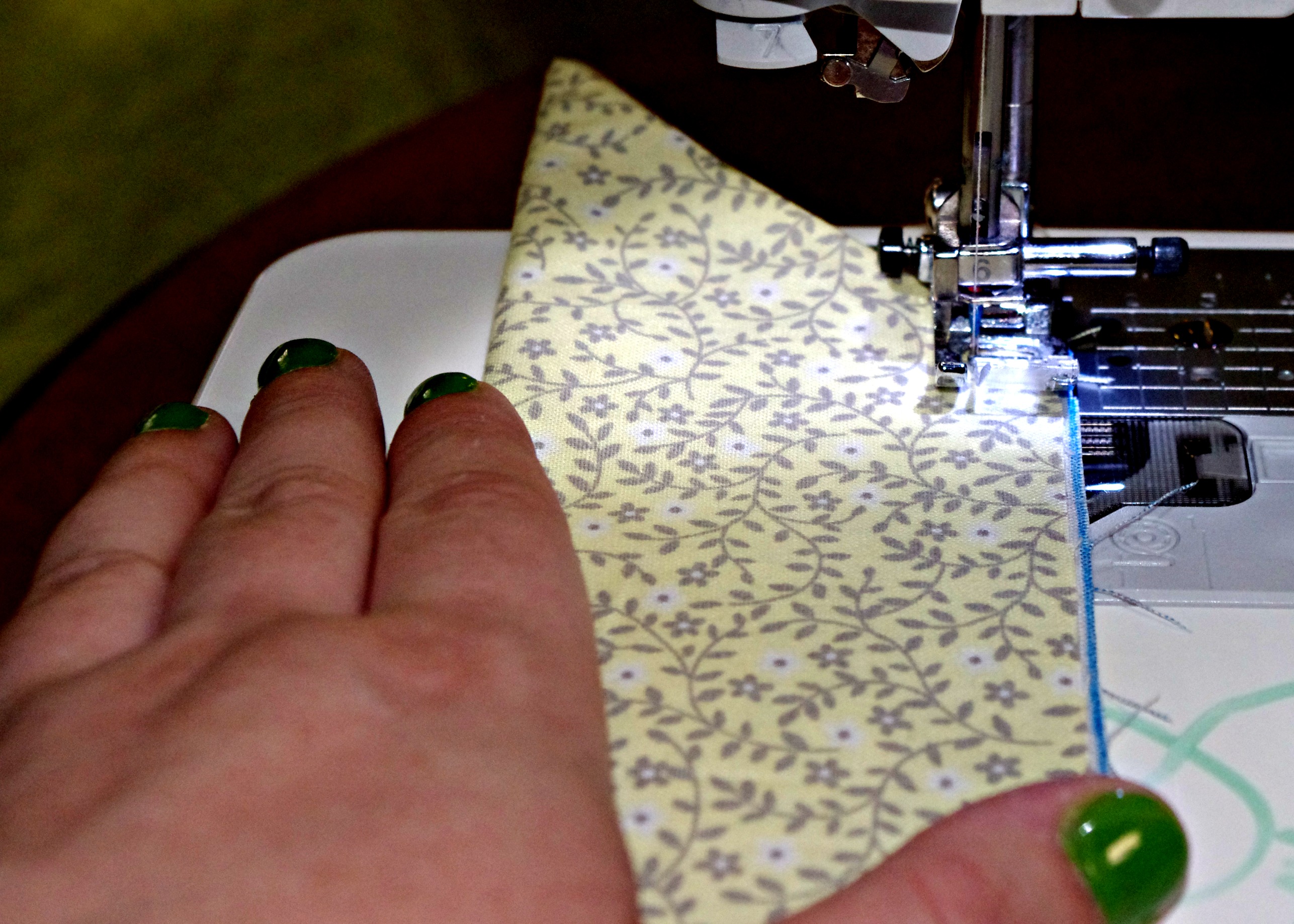
NT Sew middle

Fold the tie in half, matching up the unfinished sides. (You’re sewing the center seam that will run down the back of the tie.) Whichever fabric is your main fabric should be on the inside of the fold. You should be looking at your contrast fabric as you sew. Sew the entire length of the tie, matching the unfinished sides together. 

NT right side out

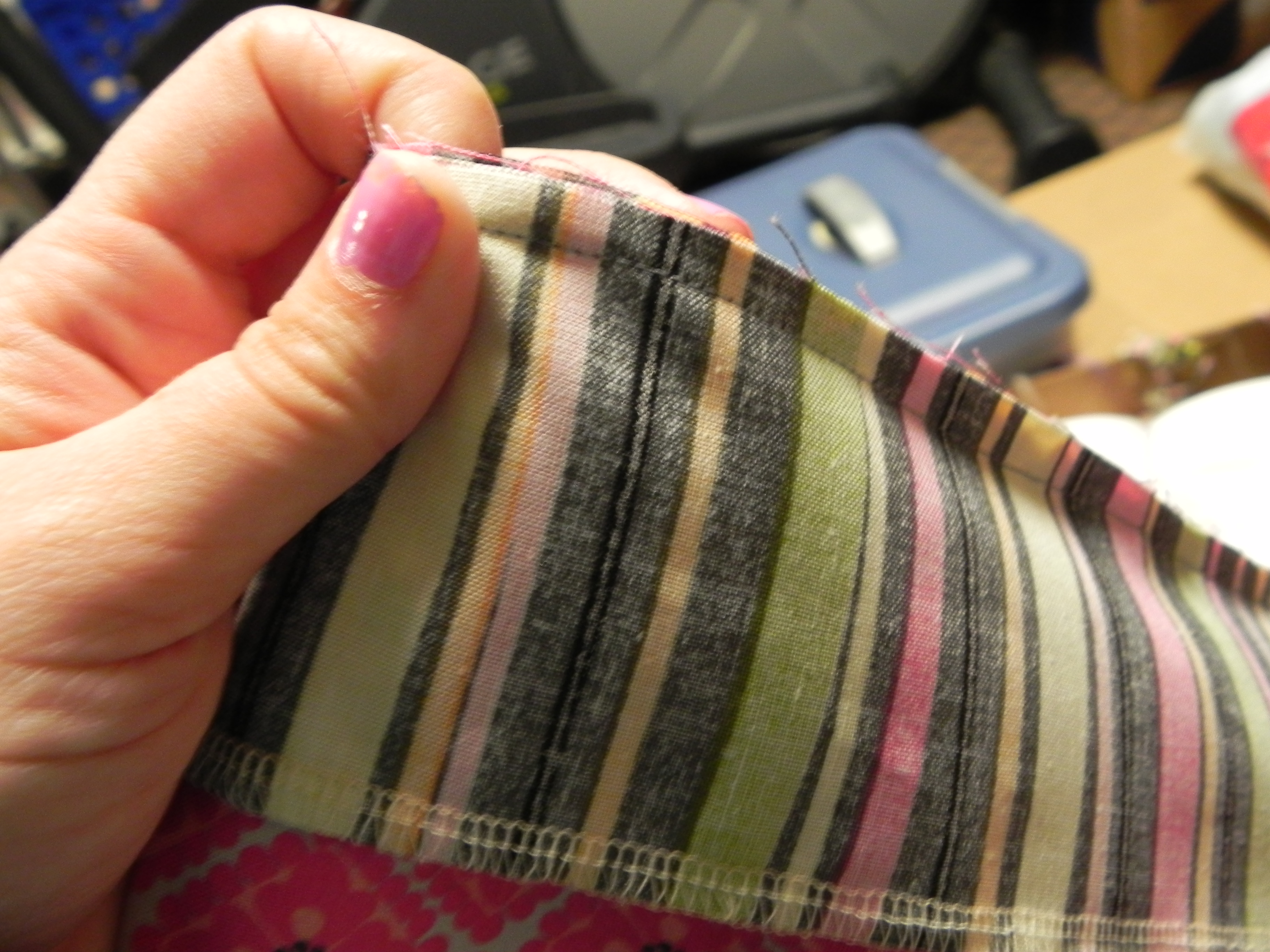
Flip your tie right side out. Press it into the tie shape. The seam should be running down the center back. You can be done here. I do a little extra step because The Pastor (who is the tie expert in my house) says it makes a big difference in how a tie feels. 
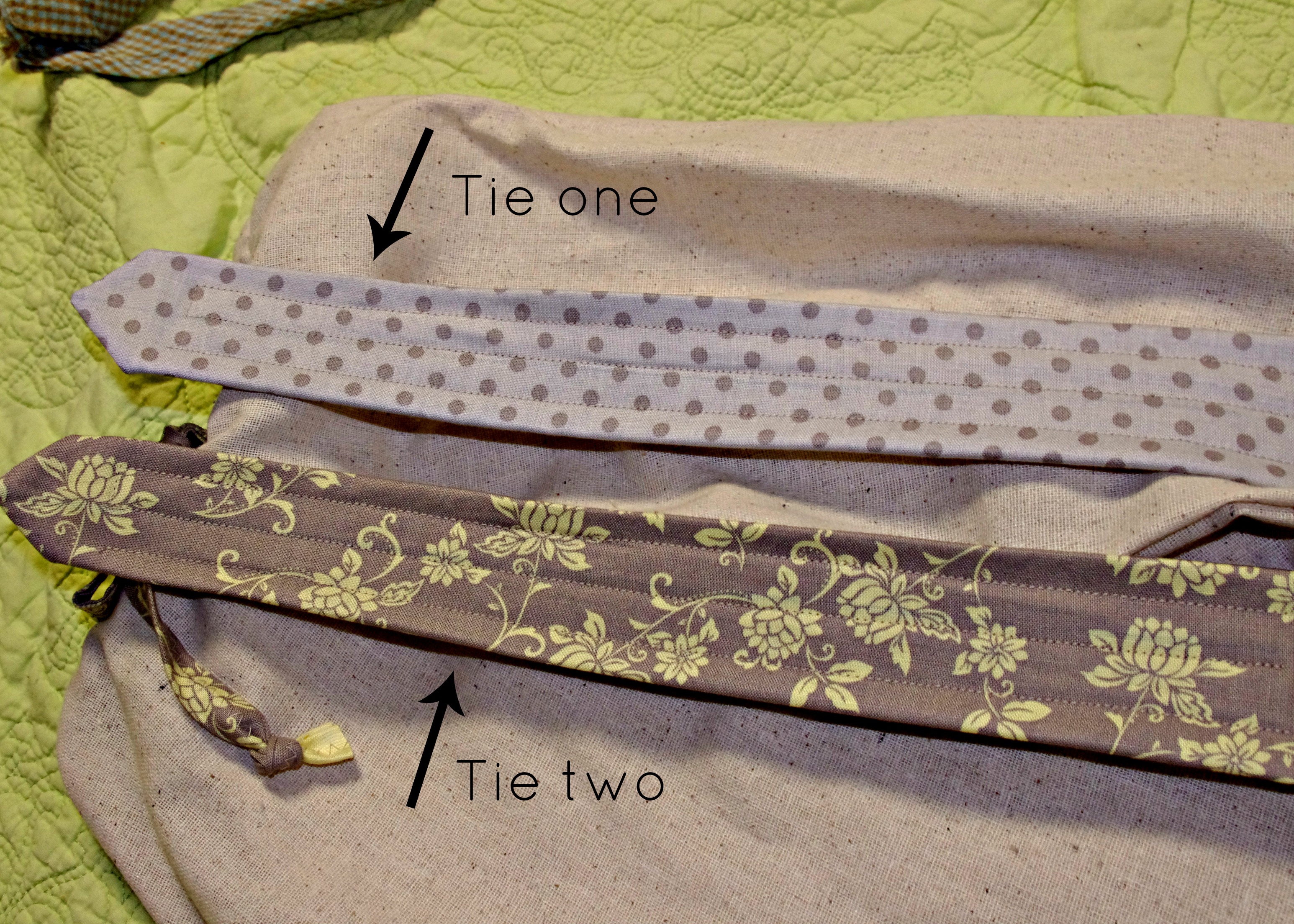
NT optional end


See the topstitching on these ties? That is the “big difference”. Just sewing a few straight lines down the narrow 1/3 end of the tie. The Pastor says this makes a ties lay flat on your neck and makes it much more comfortable to wear. I just trust him on it. And it only takes a minute, so I go with it. 
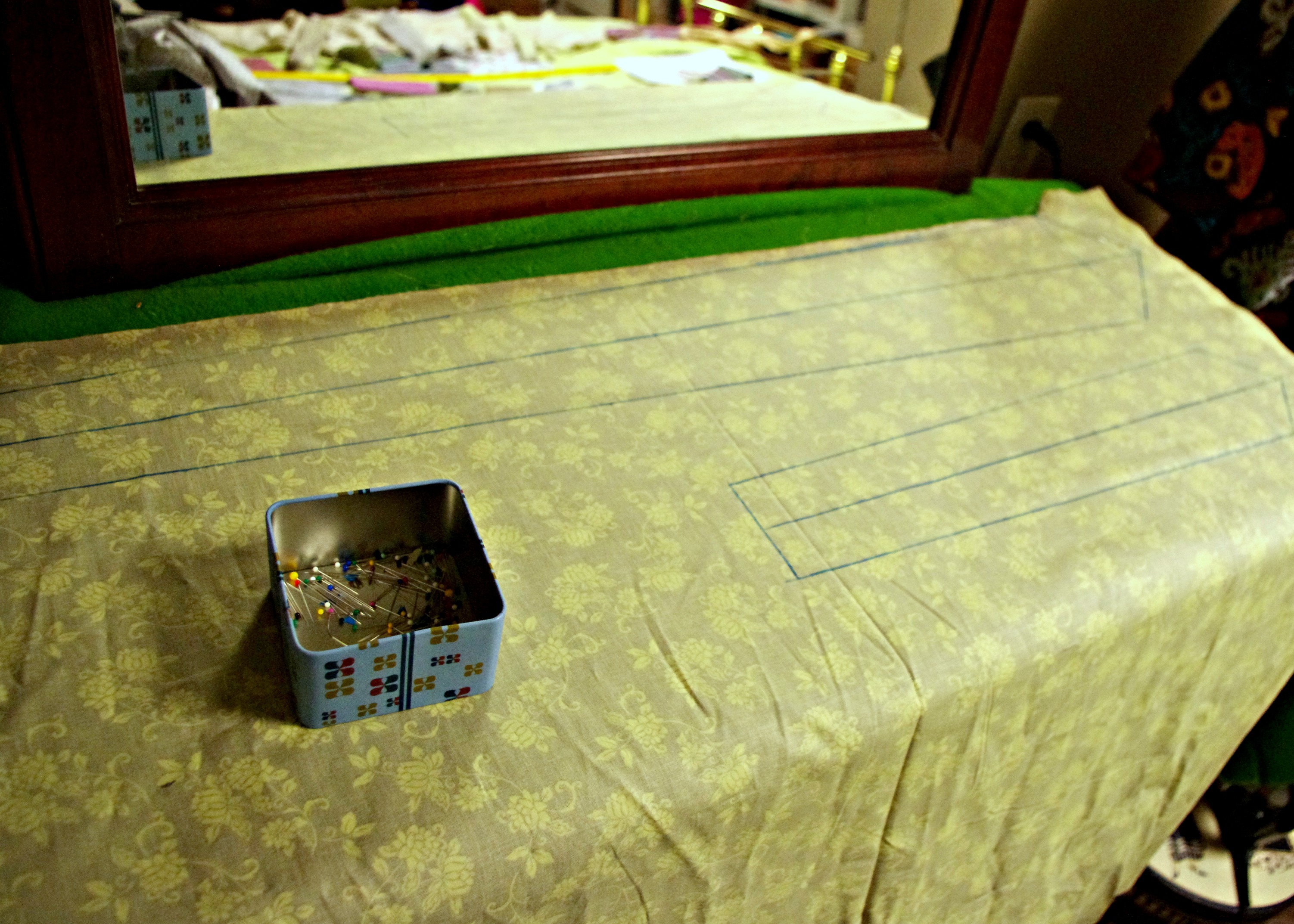
NT adult variation

Now for the adult variation:

You’ll want the tie longer. So, it’ll have to be longer than the width of your fabric. I made mine with one 36″ piece and one 18″ piece. It was long enough. You could make it longer if your man has a thicker neck or like super elaborate knots.

You’re making it essentially the same way. So lay your fabric out the same way. I made the large end 4.5″ from the center. I made the small end 3″ from the center. Now, you’ll need to make the ends that will connect the same width. Just make sure you mark it the same on both pieces. Connect the end of the lines in the same way. (See the picture.)

NT adult variation 3

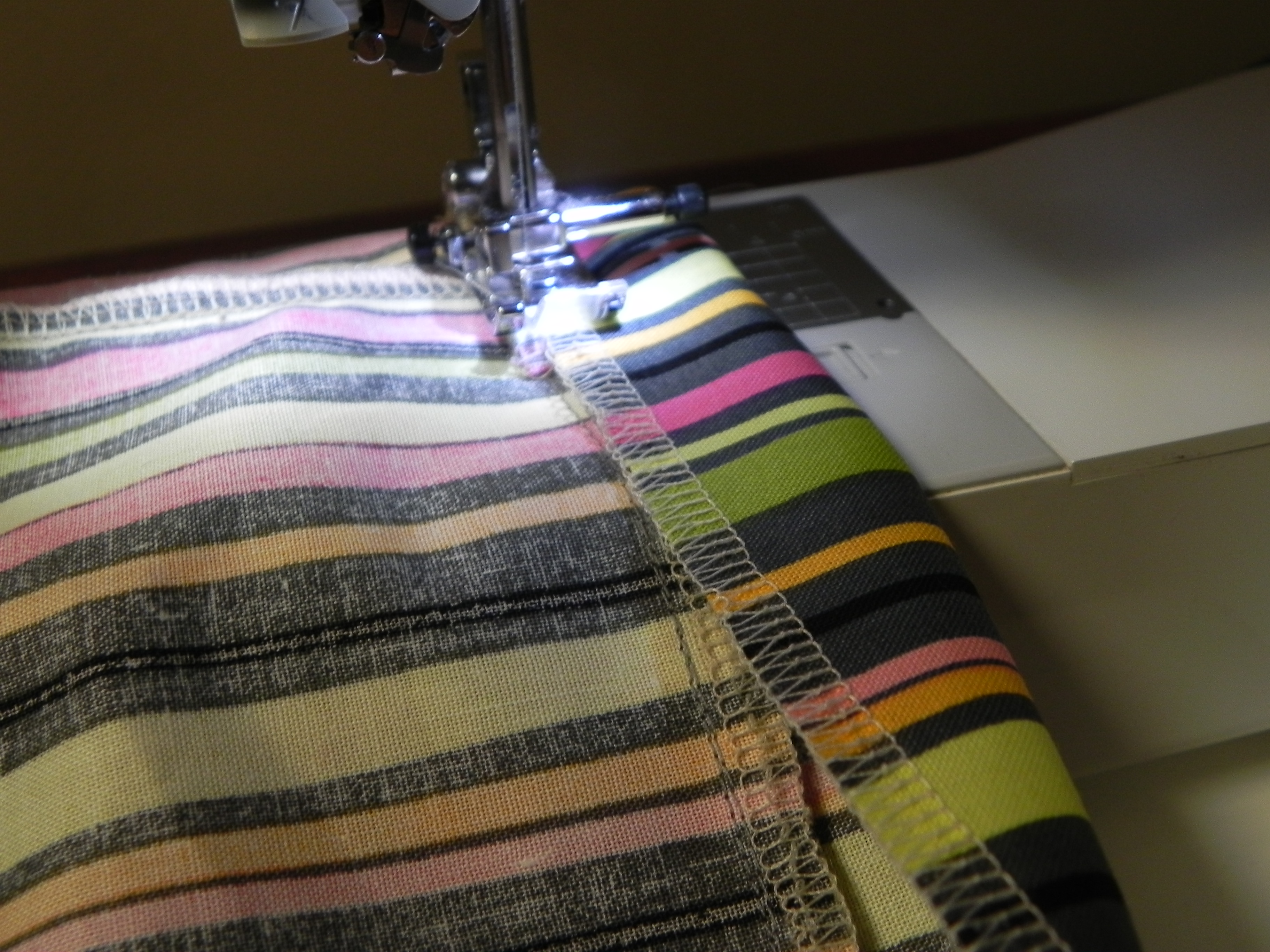
Sew the ends the same way you sewed the ends for the little boy version. Once the ends are sewn, match up the straight ends in the middle and sew them together. Sew the main fabric to the main fabric right sides together. Sew the contrast fabric to the contrast fabric right sides together. 

Flip it right sides out, pressing out the ends. Also, press the seams open. (It’ll make the tie lay flat. If you press them to the side, you’ll make little speed bumps in your tie.)

Now you’ll finish up the same way as the little boy tie. With the main fabric to the inside, fold tie in half and sew the unfinished sides together. Flip.

Press. Sew the lines on the narrow 1/3 of the tie if you want

.


And that is it! You’re done! Well, if you’re like me, you repeat over and over and over and then you’re done.


As usual, you can make these for your loved ones, give them as gifts, sell them if you want. You made them! Just share the free tutorial if asked! 


Filed Under: Crafts, Uncategorized Tagged With: easy necktie pattern, free, free necktie pattern, free pattern, free sewing pattern, free sewing tutorial, free tutorial, necktie pattern, sewing, sewing clothes for boys, sewing for boys

Lenten Family Devotion Week Seven 

February 21, 2024 by notesfromtheparsonage 1 Comment

What you’ll need this week: This week, we’re making a wreath, adding a bit each day. For the wreath, you can pick up a twig wreath at a craft store very inexpensively. You can decide if you’ll just make one wreath for the family or if each person will make their own. (They can always gift them to Grandma on Easter.) You’ll need to attach the items each day. Hot glue works, but using floral wire to tie things on and in works better. In addition to the wreath, you’ll need: 
– Something gold (like garland or a sprig of gold)

– Feathers (or birds, whatever you happen to find and like)

– Something purple (it can be a flower, ribbon, fabric- it is up to you)

– Something black (flower, ribbon, do-dad, whatever you like)

– Something linen (ribbon, scrap of fabric, flower, butterfly)

– Something white (flower, ribbon, butterfly, lily, etc.)

Day Thirty-Seven: Monday: Betrayal & Arrest

Read John 18:1-14

OR

Jesus Is Arrested, p.210-211 in Jesus Calling Bible Storybook

OR

A Dark Night In The Garden, p.294-301 in The Jesus Storybook Bible

Discussion:

– Judas saw all the same miracles that Jesus performed as the rest of the disciples. Why do you think he would betray Jesus?

– Peter the bold stepping up again and cutting off a dude’s ear! Why do you think Jesus rebuked him?

Activity:

– Today, we’re adding some gold to our wreath to represent the betrayal of Jesus.

Day Thirty-Eight: Tuesday: Peter’s Denial

Read John 13:36-38; 18:15-18; 18:25-27

OR

Peter Denies Jesus, p. 212-213 in Jesus Calling Bible Storybook

Discussion:

– Why did Peter deny Jesus?

– What do you think went through Peter’s head as the rooster crowed?

– Do you ever try to hide your faith?

Activity:

– Adding to our wreath some feathers to signify the rooster crowing at the betrayal of Christ.

Day Thirty-Nine: Wednesday: Jesus’ Trial

Read John 18:28-40; 19:1-6 and Luke 23:1-25

Discuss:

– Did Pilate want to punish Jesus? Why did he agree to it?

– Why would the people choose Barabbas’ release over releasing Jesus?

– Was any of this fair?

Activity:

– Today, we are adding purple to our wreath, like the robe used to mock Jesus.

Day Forty: Thursday: Crucifixation

Read John 19:16-37 and Luke 23:26-49

OR

The Sun Stops Shining, p. 302-307 in The Jesus Storybook Bible

OR

Good Friday, p.214-219 in Jesus Calling Bible Storybook

Discussion:

– Take some time to discuss the impact of the crucifixion on your hearts today. What does the death of Christ mean? If you need a big word to focus on, Justification and Atonement are good ones to explore.

Activity:

– Though Good Friday is tomorrow, we’re taking time today to reflect on what is coming. Today, we’ll be adding black, the color of mourning, to our wreath.

Day Forty-One: Friday: Burial of Jesus

Read John 19:38-42 and Luke 23:50-56

OR

The Sun Stops Shining, p. 308-309 in The Jesus Storybook Bible

Discuss:

– What do you think the soul of Jesus was doing while his body was being buried?

– How do you think His followers felt?

Activity:

– Today, we’re adding linen to our wreath, to represent the linen they wrapped Jesus in.

Day Forty-Two: Saturday: Resurrection

We’ve made it through. Today, is the last day of Lent. While today is the day the world waited. Tomorrow will be Easter, and look forward to his Resurrection.

Read John 20:1-10 and Luke 24:1-40

OR

Easter Sunday, p.220-223 in Jesus Calling Storybook Bible

OR

God’s Wonderful Surprise, p.310-317 in The Jesus Storybook Bible

Discussion:

– Do you find it interesting the Jesus first appeared to women?

– When they first realized the body was gone, what do you think they thought happened?

– What does the Resurrection mean for us?

– What have you learned about Justification, Atonement, and Redemption?

Activity:

– Today, we finish our wreath. We add white, the color of the resurrection. And now your Easter wreath is complete. Hang it up or plan to gift it to someone special tomorrow, to remind them of the hope of Easter.

Filed Under: Faith, Seasonal Devotionals, Uncategorized Tagged With: devotion, family devotion, free, kids, Lent, Lenten Devotion, parenting

Lenten Family Devotion Week Six

February 21, 2024 by notesfromtheparsonage 1 Comment

This week you will need: 
Day Thirty-one: toilet paper

Day Thirty-two: old magazines, catalogues, newspapers, etc., white school glue, scissors, card stock

Day Thirty-four: canvas or canvas board and paint

Day Thirty-five: copies of the coloring page

Day Thirty-six: large piece of chip board, paint, drill, twine

Day Thirty-One: Monday: Lazarus

Read John 11:1-44

OR

Jesus Heals the Sick: Lazarus Is Raised!, p.194-195 in Jesus Calling Bible Storybook

Discussion:

– What do you make of verse 4?

– Why dis Mary and Martha blame Jesus for the death of their brother?

– More paradox! What paradox do we find in this passage?

– Did you know John 11:35 is the shortest verse in the Bible?

– What do you think this experience was like for Lazarus?

Activity:

– Wrapping The Dead: Split into teams. However many teams your family wants to make. You need at least two people per team. Each team gets a roll of toilet paper. On your mark, get set, go! First team to completely wrap one member and have that person play dead on the floor wins! When all Lazaruses are dead, yell, “Come forth!” And have all the Lazaruses jump up alive again!

Day Thirty-Two: Tuesday: Zacchaeus

Read Luke 19:1-10

OR

The Man Who Didn’t Have Any Friends (None), p.264-271 in The Jesus Storybook Bible

OR

Zacchaeus Meets Jesus, p.196-197 in Jesus Calling Bible Storybook

Discussion:

– Did Zacchaeus’ money grant him access to Jesus?

– How did meeting Jesus change Zacchaeus’ life?

– Has salvation come to your house?

Activity:

– A Tree Made of Trash: Gather your supplies. Old newspapers, magazines, catalogues, etc. Plus you’ll need glue, scissors, and card stock. On the card stock, you’re going to glue your pieces to make your tree. To make a tree trunk and branches, take a piece of scrap paper from a magazine or whatever, brush glue on the piece, roll it as tight as you can. Glue the roll onto your card stock. Once you have your trunk all made with as many rolls of paper as you need, cut leaf shapes out of scrap paper and glue them to the tree. If you want, find a man and cut him out and glue him in the tree. After this dries, hang it with the rest of your Lenten art.

Day Thirty-Three: Wednesday: Triumphant Entry

Read John 12:12-19

OR

Palm Sunday, p.204-205 in Jesus Calling Bible Storybook

Discussion:

– Why were the people praising Jesus?

– Why a donkey?

Activity:

– Palm Parade!: Grab some palm branches and have a parade through your house, your yard, your neighborhood- whatever works. Praise God for the good things He has done! If you don’t have palm branches, make do by grabbing other branches or flowers or even just waving scarves.

– Read the following Poem:

The Donkey

BY G. K. CHESTERTON

When fishes flew and forests walked

And figs grew upon thorn,

Some moment when the moon was blood

Then surely I was born.

With monstrous head and sickening cry

And ears like errant wings,

The devil’s walking parody

On all four-footed things.

The tattered outlaw of the earth,

Of ancient crooked will;

Starve, scourge, deride me: I am dumb,

I keep my secret still. 

Fools! For I also had my hour;

One far fierce hour and sweet:

 There was a shout about my ears,

 And palms before my feet.
Day Thirty-Four: Thursday: The Lord’s Supper

Read Mark 14:12-25

OR

The Last Supper, p.206-209 in Jesus Calling Bible Storybook

OR

The Servant King, p.286-293 in The Jesus Storybook Bible

Discussion:

– What was Passover?

– Does this bread and wine sound familiar to you?

– Did you know that in the early church, there were rumors that Christians were can I like cannibals because of this sacrament?

Activity:

– The Last Supper Painting: Check out the image of the Last Supper. Recreate it in your own way. I suggest providing good art supplies for this one. Canvas and paint. You could also do canvas board, if you choose. Younger ones may prefer to just draw the bread and the cup. When the masterpieces are complete, hang them with the rest of your Lenten art.

Day Thirty-Five: Friday: Jesus Washes Feet

Read John 13:1-20

OR

The Servant King, p.286-293 in The Jesus Storybook Bible

OR

The Last Supper, p.206-209 in Jesus Calling Bible Storybook

Discussion:

– Jesus knows that Judas is going to betray Him, yet He washes his feet along with the rest of the disciples. Discuss.

– What is the significance of Jesus washing the feet of everyone else?

– What dumb things does Peter say this time?

– Paradox! What is the paradox in this passage?

Activity:

– Since we already washed feet, we won’t repeat. Unless you skipped it then. If you skipped it, by all means have a foot washing. For the rest of us, here is a coloring page.

Day Thirty-Six: Saturday: Holy Spirit

Read John 14:15-31

Discussion:

– Jesus says, “If you love me, you will keep my commandments”, would you say that is true?

– Jesus is telling His disciples He is going to die, yet He also tells them not to be afraid- why?

– Who is The Ruler of This World?

– If Jesus is leaving, how will the disciples not be orphans?

Activity:

– Holy Spirit, You Are Welcome Here Sign: We’re going to make a sign! You’ll need a large piece of chip board. Grab the paint, let’s get to work. Paint the background. You can paint it white. You can let each child paint a portion of the background. In our house, we’re just making one sign. If you want, you can let each child make a smaller version. It is up to you. Once the background is painted and dried, paint the letters. “Holy Spirit, You are welcome here!” You can do part in cursive and part in script. You can use stencils if you are uncomfortable painting the letters. You can use a pencil or chalk pencil to write the letters before you commit to paint. Leave some room at the top for the holes to hang it. Once your letters are painted and dry, grab your drill and drill two holes in the top large enough for twine to pass through, but not so large a knotted piece of the twine will pass through. Cut a piece of twine, feed it through the holes, and tie a knot in each end. Now you can hang the sign! If you’re wanting to hang it outside, you’ll want to either rub it with some furniture wax, which will distress it, but protect it. Or you can spray acrylic fixative spray on it for a clear finish. Or hang it as is inside the house.

Filed Under: Faith, Seasonal Devotionals, Uncategorized Tagged With: devotion, devotions with kids, faith, family, femily devotions, kids, Lent

Lenten Family Devotional Week Five 

February 21, 2024 by notesfromtheparsonage 1 Comment

Week FiveThis week you will need:

Day Twenty-six: sticks from your yard, twine

Day Twenty-seven: baking soda, grape juice concentrate, paint brushes, paper, water

Day Twenty-eight: cotton balls, paper, and glue for the alternate craft

Day Thirty: stones you can write on, chalk marker

Day Twenty-five: Monday: Peter’s Confession

Read Luke 9:18-20

Discussion:

– Why would people think Jesus was John the Baptist, Elijah, or a risen prophet back from the dead?

– Pete finally understands who Christ is and proclaims it. Do you proclaim that Jesus is Lord?

– Does your life reflect your confession of faith?

Activity:

– Jesus Is Lord Experiment: Today, we’re going to write “Jesus Is Lord” on our arm or hand. I’d use a Sharpie, but if you want to use a washable marker, that will work, too. Now, if we publicly proclaim He is Lord, how should we live? How should we act? At the end of the experiment, discuss with one another what you found. Did people notice? Did it remind you of who you want to be?

Day Twenty-Six: Tuesday: Take Up Your Cross

Read Luke 9:23-27

Discussion:

– Here, again, we have this idea of paradox. To save your life you must loose it. Lose your life and you’ll save it. Discuss paradox again.

– What does it matter if you gain the whole world but lose your soul?

– What does it mean to take up your cross?

Activity:

– Make Crosses: Gather some sticks from the yard. Break or cut them with kitchen scissors down to appropriate cross sizes. Use twine to tie the sticks together. Hang them with your other Lenten artwork.

Day Twenty-Seven: Wednesday: Transfiguration

Read Luke 9: 28-36

OR

The Glory of Jesus, p.202-203 in Jesus Calling Bible Storybook

Discussion:

– What do you think about Peter’s suggestion?

– What do you think Jesus, Moses, and Elijah were talking about while the disciples slept?

– Why did Jesus only take 3 of his disciples?

– What do you think glory even looks like?

Activity:

– Secret Message: You will need baking soda, water, and grape juice concentrate. Mix together equal parts of baking soda and water. Use a paintbrush to write a message on a piece of paper. Watercolor paper will stand up best to the liquid, but any paper will work. Let the message dry. Trade papers. Paint the page with grape juice concentrate to reveal the secret message!

Day Twenty-Eight: Thursday: 72 Go and Come

Read Luke 10: 1-12; 17-20

Discussion:

– Do you think these 72 were thinking they might die?

– Do you think these 72 really had any idea what they were doing?

– Would you have been comfortable traveling with no provisions?

– What is peace? How can we strive to have it in our home?

– The Kingdom of God came near no matter what the people did. Why is this significant?

Activity:

– Sheep Among The Wolves Game: Everyone sit in a circle and close your eyes. I will tap one of you. You will be the sheep. Everyone else is a wolf. Then we will go around and ask questions (to me) about who is the sheep. You cannot ask if it is a specific person. You can only ask yes or no questions, like, “Is their favorite color red?” “Do they have a lot of hair?” Etc. I will answer yes or no for the sheep. Play a few times so everyone has a chance to be the sheep.

– Alternate activity: Draw a sheep on paper. Glue cotton balls onto the sheep to make him fluffy.

Day Twenty-Nine: Friday: The Good Samaritan

Read Luke 10:26-37

OR

Jesus’ Great Stories: The Good Samaritan, p.176-177 in Jesus Calling Bible Storybook

Discussion:

– How does this story answer the question, “Who is my neighbor?”

– Why was it significant that the man was a Samaritan?

– How can you be a Good Samaritan?

– Can you think of any examples of people who lived out this story in their lives?

Activity:

– Put On A Play! This is an excellent story to act out. Even better if you’re willing to get out some supplies to really wrap the injured man up. (An ace bandage, some band aides, a roll of toilet paper.) You’ll need a man, robbers, priest, Levi, Good Samaritan, and an Inn Keeper. If you have an extra person for a donkey, awesome! If you need to duplicate parts, no worries. It is just for fun!

Day Thirty: Saturday: The Woman In Adultery

Read John 8:1-11

Discussion:

– Why would they bring this woman to Jesus?

– What do you think Jesus wrote on the ground?

– Why did no one throw a stone?

– What would it mean to go and sin no more?

Activity:

– Transgressions on Stones. Sometimes we need a physical reminder to drop the guilt, the burdens that we carry. Grab a chalk marker, help the younger kids, write on stones the things you are sorry for. Write the burdens that hold you back. Now take your stones outside and drop them one by one. Once it rains, the words will be washed away. Or you can grab the hose and wash them away right now so you can see the words disappear.

Filed Under: Faith, Seasonal Devotionals, Uncategorized Tagged With: devotions, devotions with kids, faith, family, family devotions, kids, Lent, Lenten Devotion

Pixie Skirt Sewing Tutorial

February 16, 2024 by notesfromtheparsonage 5 Comments

Pixie Skirt Tutorial collage image with purple pixie skirt on top and green and blue pixie skirt on bottom

This Pixie Skirt sewing tutorial has two size variations included. You could also call this skirt a “petal skirt”. One size is for larger kids, the other for smaller kids. The best way to know which size suite your little pixie is to measure! The smaller skirt is intended for toddlers and small preschoolers. While the larger skirt will work for preschoolers up to about a size 8 or so. (You could even adapt it to make a bigger third size.)

Pixie Skirt Tutorial collage image with purple pixie skirt on top and green and blue pixie skirt on bottom

For the larger size pixie skirt, you’ll be making longer, fuller petals. The longer length and fewer petals make it perfect for older girls. You’ll want to pick two or three different cotton fabrics and have about 3/4 of a yard of each. (You can make the underside of the petals in a solid color if you like. Or you can make each petal different if you’re daring.)

Making a Petal Pattern

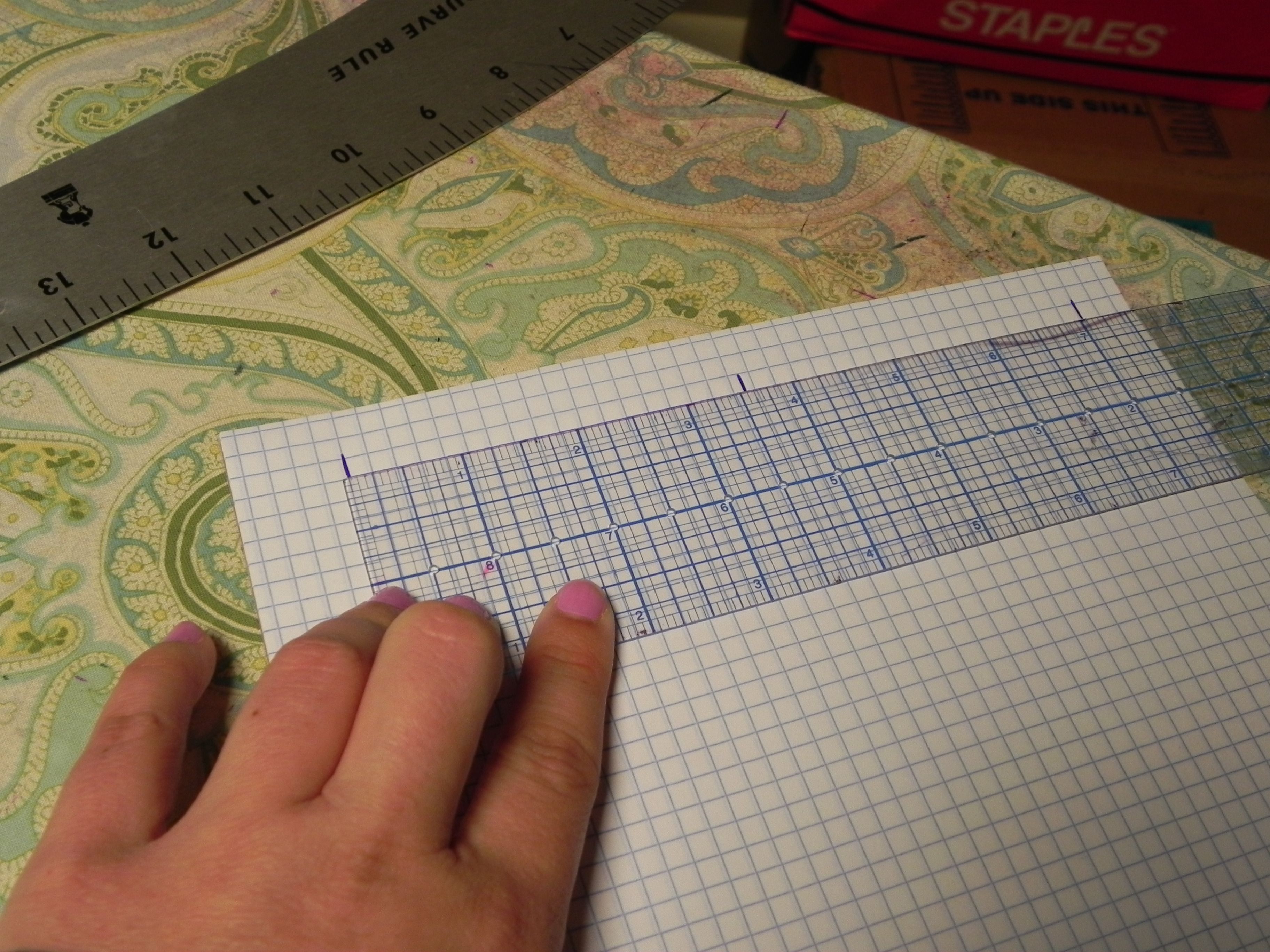
Measuring on graph paper to make the petals for the top of the skirt.

First, you’re going to make your petal pattern. So, grab your graph paper (or whatever paper you make your patterns on), your straight ruler, your curve ruler (if you have one- if you don’t, you can eyeball it), your pen, and your paper scissors (never to be confused with your fabric scissors!).

Mark a line on the top of your paper 7″ across. Put a little mark at the halfway (3.5″) point.

Measurements for the longer petals for the larger size pixie skirt.

Draw a line down the center mark 10″ down. The bottom of the 10″ mark is the bottom of your petal.

Folding the graph paper in half to make equal sides.

Fold the paper in half along the center line. Also, note how I marked the bottom of the 10″ line. Once your paper is folded, it can be hard to see where the end of the line is.

French curve ruler to make a petal pattern for pixie skirt.

Grab your curve ruler and draw a curved line from the end of your 7″ line to the end of your 10″ line. If you don’t have a curve ruler, you can just eyeball this part. You are only marking one side of your folded paper.

Petal Pattern for larger pixie skirt is made.

Keeping your paper folded, cut along the curved line.

Different petals for the larger pixie skirt.

Unfold your petal. This is your pattern piece. Write all the necessary stuff on you pattern piece. I usually include the dimensions of the pattern piece and the dimensions of the pieces that are to go with it. Also, not the two pattern pieces above. Your pattern is your own. It may be more pointy or round than mine. In fact, you can make triangles and make a Pennant Skirt if you like. (That would be super cute in the summer for baseball season.) If you don’t like the shape when you unfold it, try again. For my skirt, I used the left pattern. I liked the rounded look of it.

Cutting the Fabric for Your Pixie Skirt

Fabric pieces for larger pixie skirt cut out

Now, you are going to cut out all your skirt pieces. You will need to cut out 12 petals (front and back will make 6 completed petals). You’ll need 2 rectangles for the skirt body 20″ wide and 14″ long. You’ll also need 2 skinny rectangles for the waistband 19″ wide and 3″ long. (Note my pretty new scissors that The Pastor bought me for my birthday! He knows the way to my heart is not jewelry, but sewing accessories!)

Pixie Skirt petals cut with two placed together right side together.

First, we’re going to work on the petals. Take two of your petal cut outs and place them right sides together.

Sewing Petals

Trimming the curved edges of the petals

Sew around the edges, leaving the top open. Since these seams will be completely enclosed, there is no need to finish them. Clip the curves all the way around your petal so that when you flip it right side out, it lays nice and flat.

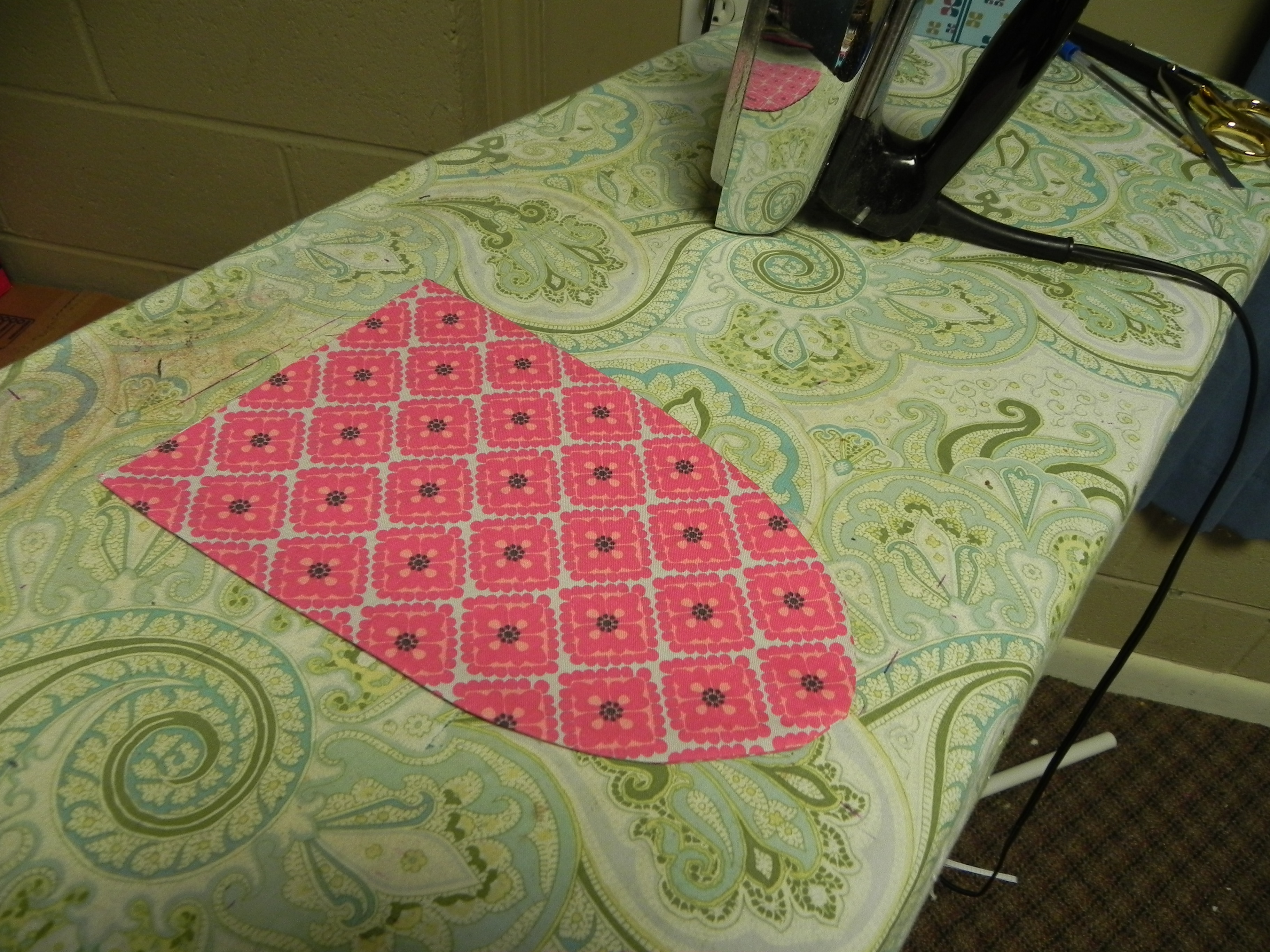
Petal turned right side out and pressed.

Repeat for the other 5 petals. Flip them right side out and iron them flat. If you want, you can topstitch once you’ve ironed them flat. I didn’t on this skirt, but have on others. It is really just for looks, so do whichever you prefer at the moment.

Sewing the Under Skirt

Sewing the under skirt fabric right sides together on the sides.

Set your cute little petals aside and let’s work on this underskirt. With the right sides together, sew the short sides of the two rectangles together, making a tube.

Finishing the edges of the under skirt

Go ahead and finish the side seams of your skirt. I serged mine. You can finish them however you like!

Hem the bottom of the under part of the pixie skirt.

You are also going to go ahead and finish the bottom of the underskirt. You can do a double fold hem if you like. I serge mine, then flip that under and sew it down. I use a zig-zag stitch just because I like how it looks.

Putting Petals onto the Pixie Skirt

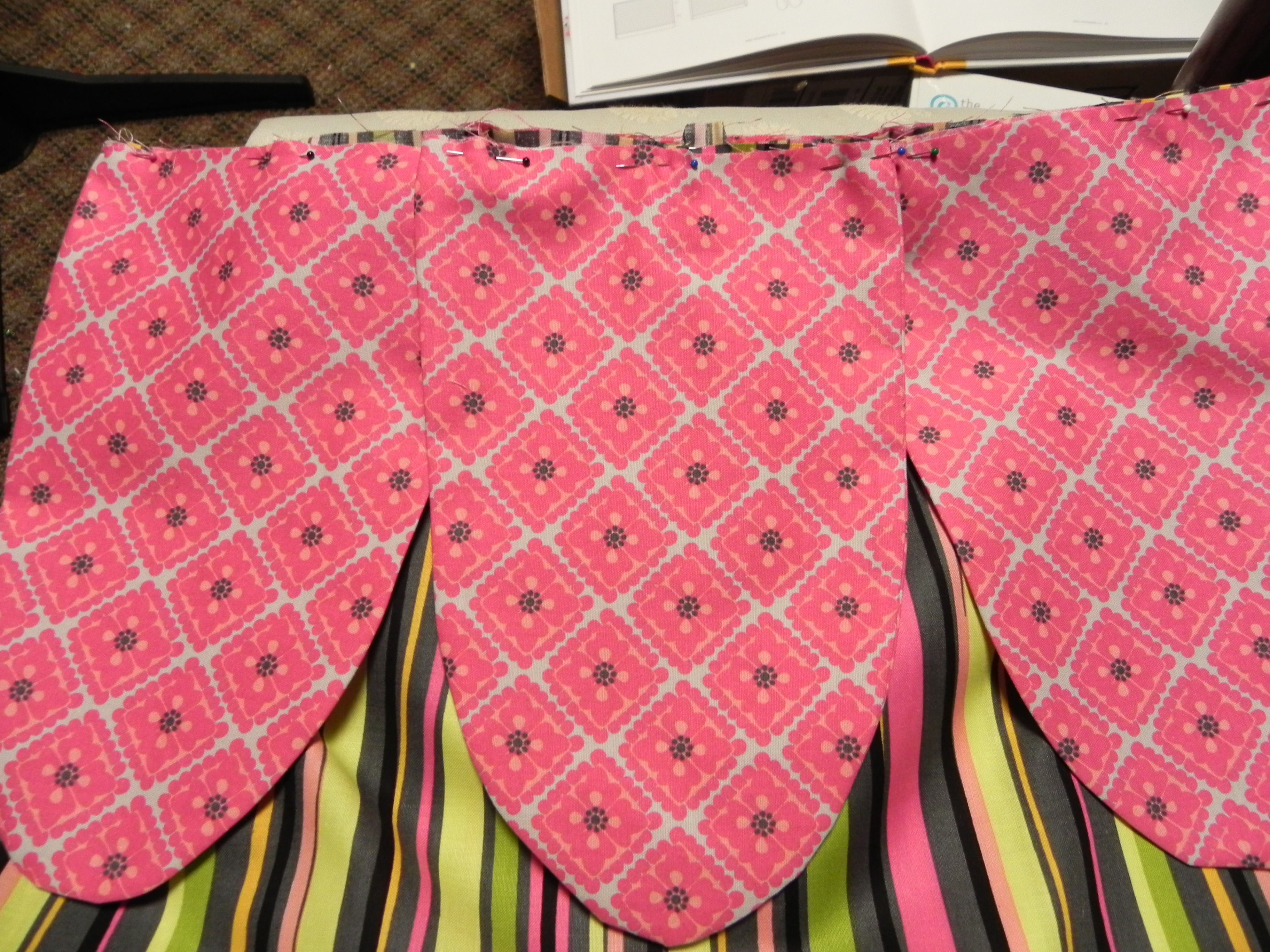
Petals pinned to the under skirt of the pixie skirt

Pin your petals to the outside of the underskirt. I like mine to overlap a little bit. You arrange them how you want. There will probably be about 1/2″ more underskirt than there are petals. You are going to box pleat the center front and back underskirt. The size of the box pleat depends on how you want your petals arranged.

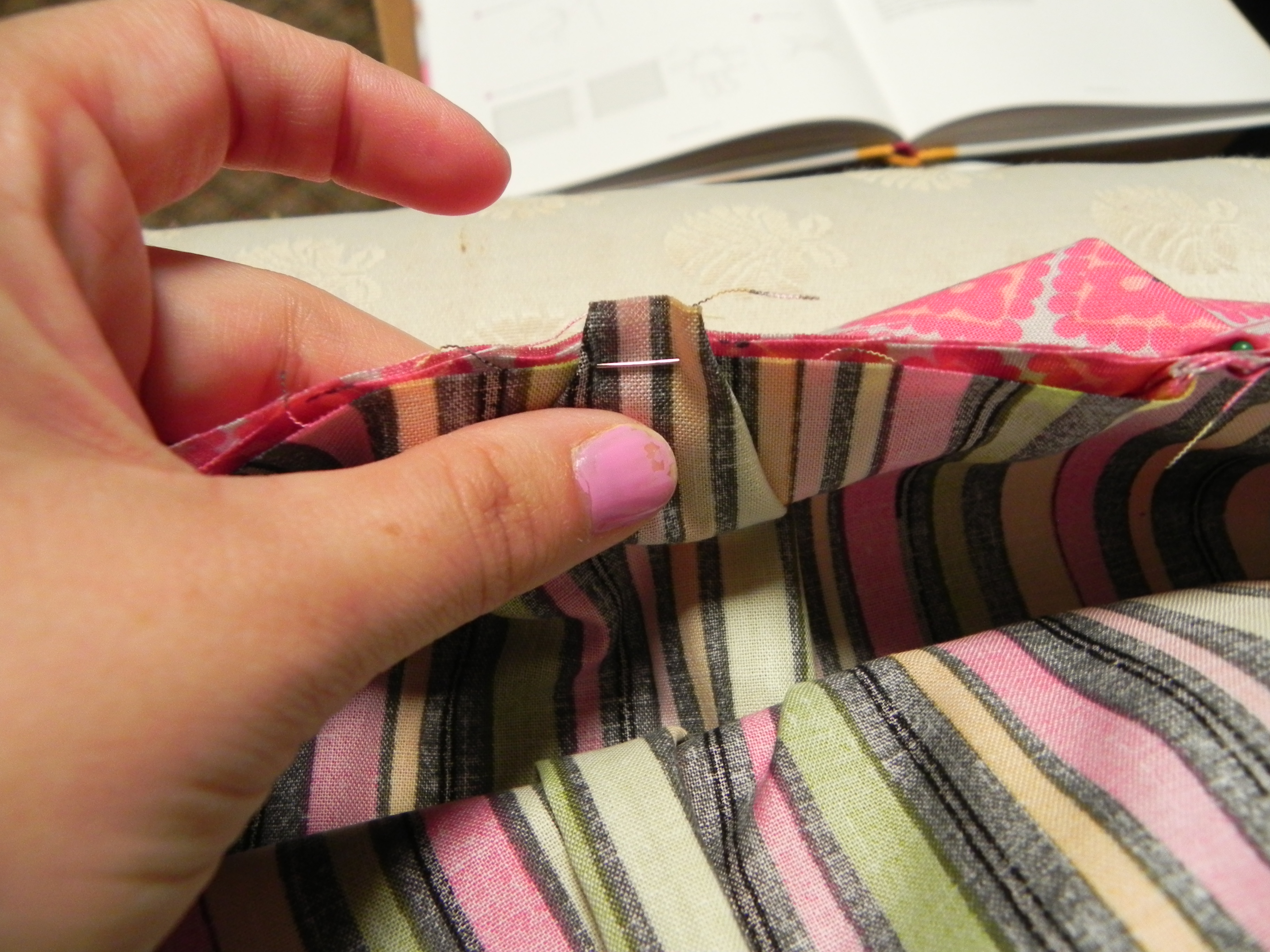
Box pleat on under skirt of pixie skirt

This is the best picture I have of the pleat. I like the pleat, because it adds just a bit of volume to the skirt. However, if you don’t like the pleat, take about an inch off the width of the underskirt. I usually don’t do the pleat for the Pixie Skirt, since it is smaller and shorter and naturally holds a little more volume.

Sewing the petals onto the pixie skirt

Sew the petals to the underskirt. Make sure you sew close to the top edge.

Adding a Waistband

Adding the waistband to the pixie skirt

Sew the short sides of the waistband together (with right sides together). I go ahead and serge what will be the top of my waistband. You can do it now or later, it really doesn’t matter. With the right side of the waistband facing the right side of the skirt, sew the waistband to the skirt.

Sewing the waistband so there is a casing for elastic

Fold the waistband over and sew it closed, leaving a small hole to feed the elastic through. It may be easier if you press the waistband fold before you sew. You do whatever works for you. I didn’t want to walk across the room to the iron, so I just flipped it and eyeballed it.

Hole left to feed elastic through.

Here is the hole I left for the elastic.

Elastic with pins on both sides to feed through the channel made in the waistband of the pixie skirt.

My elastic is now ready to thread through the waistband! The length of elastic you cut will depend on two things. The first is the girl who will wear the skirt. Clearly, skinner means shorter elastic. Wider means longer elastic. The maximum waist on the skirt is about 37″. The second factor is what kind of elastic you are using. I use a gentler elastic that doesn’t dig in or squeeze as tight. I find it more comfortable to wear. Your elastic may squeeze tighter, therefore you’ll want it a bit wider than I make mine. Eyeball it.

Elastic stitch on the elastic.

Thread the elastic through the waistband. Sew the elastic closed. When sewing elastic closed, you want to sew along the length with a stretch stitch (or a zig-zag). I always sew about an inch, that way there is very little chance of an overly zealous dresser snapping it.

Closing the elastic hole of the waistband.

Sew the hole closed and YOU ARE DONE!

Larger size petal skirt with striped under skirt and blocked top skirt.

Finished Pixie Skirts

Blue and green pixie skirt with band at the bottom of underskirt.

Pixie Skirt in green and blue paisley. I added a matching hem band on the bottom of this one by sewing a 3 inch strip of the contrasting fabric around the bottom of the main skirt panels. I tucked the edges under and sewed around the edges, like using bias tape.

Pixie Skirt in purple and pink in front of blooming azaleas.

Smaller Pixie Skirt Dimensions

To make the smaller pixie skirt for a toddler or small preschooler, follow the directions above and just change the dimensions. (Also, don’t pleat the underskirt.)

For the petals: Make a pattern with a 7 and 3/4″ top and 8″ long. You are going to cut 16 petals for the Pixie Skirt, since you are making 8 full petals. I also make my Pixie petals a bit more pointy. It just seems right to me.

For the underskirt: Cut two 26.5″ x 11″ rectangles.

For the waistband: Cut two 26.5″ x 3″ rectangles. (If you want a more narrow waistband, try making them 2″ wide instead of 3″.)

Follow the directions for the larger Pixie Skirt.

As always, this tutorial is free for you to use in any way you like. Make them to keep, sell, gift, whatever. Just don’t take credit for the pattern because that just isn’t cool. Share the free and link back here.

Other Notes From the Parsonage Posts You Might Enjoy

  • Double Twirly Skirt Tutorial
  • Crayon Wallet Tutorial
  • Half Yard Baby Shower Gift Tutorial
  • Child’s Half Gardening Apron Tutorial
  • Wide Leg Ruffle Pants Tutorial

Filed Under: Crafts Tagged With: draft skirt pattern, free, free pattern, free projects, girl, girl clothes, petal skirt, pixie skirt, sewing, sewing for kids, sewing tutorial, skirt pattern

Word Before World

February 16, 2024 by notesfromtheparsonage 3 Comments

I’m scrolling through Instagram when I wake up this morning and come across a hashtag that gets my mind rolling. #wordbeforeworld . Now, this isn’t the first time I had seen the hashtag. I have seen @wellwateredwomen posting it for several days now. But it was the first time I stopped and took note.

What is the first thing I do when I wake up? Usually grumble about the kids already being awake and lament how late I stayed up the night before. But the first thing I usually choose to do after pulling myself out of bed and getting ready for the day is grab my iPad and start checking social media. I choose to plunge into the world first. Always. The Word part normally comes when I’ve done everything else I need to do for the day. Sure, we get into the Word every morning during Morning Basket time, so I guess I could count that. But before I even do morning basket, I’m checking my social media accounts.

Of course, my mind went to Deuteronomy chapter 6. The people of God are being told not to forget who they are and what God has done for them. They are to teach their children, talk of them in their house, talk of God’s commands walking around going about their day. They are to write them on the doorposts of their houses. And they are to think of them when they lie down and when they rise up.

It got me thinking of the giving of the first fruits, something we remind ourselves when we tithe. We give God the first of what he has given to us. So, what is more valuable than our time? The days, hours, and minutes we have? Why wouldn’t we give the first of our time each day, too?

Essentially, when I choose social media before getting into the Word of God, I’m stating my priorities for the day. Connection, news, self-image- all those things we tie up in social media- I’m saying those are the most important for me. I’m saying that my FOMO (fear of missing out) on the world is more important than my FOMO on God.

I’m not saying there is anything wrong with social media. I think we, as Christians, need to remain engaged in social media as a way to influence our culture. But as all our youth pastor’s warned us, we need to be careful of how we let it shape us. So, I’m not saying we should all pull away from social media. I think a host of evangelism can be done through a screen in our culture.

I am saying that I found myself guilty this morning. I realized I’ve not been putting first things first. I’ve been putting them last. When there is time. At the bottom of the to-do list. And those priorities will never stand. The Word will never shape me because I’m not letting it take the rightful place in my life. That is not anyone’s fault but mine.

I had thought of New Year’s Resolutions in abstract terms. I knew I needed more discipline in my spiritual life and my physical life, so I was just going to abstractly focus on discipline. I now realize an abstract one word focus isn’t going to get me where I need to be. Sure, it will help me think of where I need to be. But I need action steps. I need firm commitments to being disciplined.

So, with discipline as my word of the year, my first practical step is going to be Word before World. That is my first firm commitment to the process of being disciplined. Word before World. I will seek Him first.

Filed Under: Encouragement, Faith, Uncategorized Tagged With: Christian, church, conviction, devotion, devotions, discipline, faith, family devotional, first fruits, God first, holy, inspiration, inspirational, life, love, prayer, word, word of God

40 Holy People: A Lent Devotional for Families: Week Six

February 14, 2024 by notesfromtheparsonage 2 Comments

Stained Glass Swirl with Text 40 Holy People: A Lent Devotional for Families

This is the sixth week of our Lent Devotional for Families. We’re learning about holy people and opening our hearts to how God might make us holy, too. You can join from here, or you can go back to the beginning.

Stained Glass Swirl with Text 40 Holy People: A Lent Devotional for Families

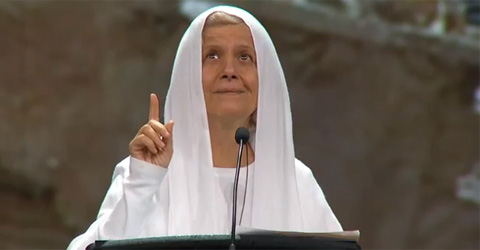
Lent Day 29: Maggie Gobran: Being The Help Needed

Picture of Maggie Groban in white pointing up in front of a microphone

How many times do we see a problem or see a need and think, “Someone should really do something about that?” Maggie Gobran saw a need and instead of looking around to see who would do something, or praying that God would somehow intervene, did something herself. Mama Maggie, as she came to be known, grew up in the middle class in Cairo Egypt. She became a Coptic Christian. She was a marketing manager and computer science professor. In other words, she was living a middle class life and had no intentions of changing that. Then she visited the Cairo garbage slums (see picture below), where people lived among garbage heaps, many of them children and many of them Coptic Christians, just like Maggie.

Picture of three adolescents in the slums in Cairo

Maggie gave up her middle class life, her jobs, her security, to go help those people she saw in the slums. She started Stephen’s Children to help the children and young people in those slums, and now other impoverished areas of Egypt. The organization seeks to show the children love, build self esteem, and hold onto the hope found in Christ. Maggie now has 1500 workers and volunteers working with her and they’ve reached more than 30,000 children and their families.

Have you noticed a need in your community? How could you meet that need?

“You know, we don’t choose where to be born, but we do choose either to be sinners or saints. To be nobody, or the heroes. If you want to be a hero, do what God wants you to do.” – Mama Maggie

Map of Egypt to Color.

Coloring Page. (A Coptic Cross)

Lent Day 30: Shane Claiborne: Making Peace

Black and white photo of Shane Claiborne wearing a bandana over his ear, glasses, and a goatee

Shane Claiborne grew up in Tennessee. Shane is the started of a New Monastic movement. We read about some ancient monks and monasteries. Shane is spreading the same concept, in a modern way. He has traveled all over the world promoting peace and helping the poor– working in Calcutta, Chicago, Rwanda, West Bank, Afghanistan, and Iraq. He now lives in Philadelphia in a faith community that help the homeless.

“Only Jesus would be crazy enough to suggest that if you want to become the greatest, you should become the least. Only Jesus would declare God’s blessing on the poor rather than on the rich and would insist that it’s not enough to just love your friends. I just began to wonder if anybody still believed Jesus meant those things he said.”

Would you be willing to travel the world to help promote peace? Would you be willing to stay where you are to do the same? What is peace?

What could you do to help the poor in your community?

Coloring Page. 

Lent Day 31: Mary: The Annunciation of Our Lord

Stained_glass_depicting_the_Virgin_Mary_holding_baby_Jesus

Annunciation is a big word that means to announce. Today, if you’re on time, is the day known as The Annunciation of our Lord. Why? Well, a pregnancy lasts 38-42 weeks, so today would have been about the time the angel came to Mary to tell her Jesus would be born.

Luke 1:26-38 (CEB)

When Elizabeth was six months pregnant, God sent the angel Gabriel to Nazareth, a city in Galilee, to a virgin who was engaged to a man named Joseph, a descendant of David’s house. The virgin’s name was Mary. When the angel came to her, he said, “Rejoice, favored one! The Lord is with you!” She was confused by these words and wondered what kind of greeting this might be. The angel said, “Don’t be afraid, Mary. God is honoring you. Look! You will conceive and give birth to a son, and you will name him Jesus. He will be great and he will be called the Son of the Most High. The Lord God will give him the throne of David his father. He will rule over Jacob’s house forever, and there will be no end to his kingdom.”

Then Mary said to the angel, “How will this happen since I haven’t had sexual relations with a man?”

The angel replied, “The Holy Spirit will come over you and the power of the Most High will overshadow you. Therefore, the one who is to be born will be holy. He will be called God’s Son. Look, even in her old age, your relative Elizabeth has conceived a son. This woman who was labeled ‘unable to conceive’ is now six months pregnant. Nothing is impossible for God.”

Then Mary said, “I am the Lord’s servant. Let it be with me just as you have said.” Then the angel left her.

An angel comes to tell Mary that her entire life is about to change. At first, she is confused, but the angel tells her all things are possible with God. She doesn’t fight it, she doesn’t argue with the angel, she fully accepts the will of God for her life. She gladly accepts this life changing news.

Coloring Page.

Lent Day 32: John & Beth Muehleisen: Encouraging Others

John and Beth Muehleisen- holy people on a mission to Uganda

John and Beth grew up in America. They currently work on the mission field in Uganda. They have been missionaries for 28 years, raising their children on foreign soil to do the work of Jesus. The main focus of ministry for John is teaching, encouraging, and empowering the ministers God is raising up in Uganda. He is helping them plant more churches and strengthen their brothers and sisters.

The Muehleisen’s have spent their entire life answering God’s call on their life. That call took them far from home and far from their comfort zones. What will you do when God calls you?

John began using a puppet names Lazarus to minister to children in Africa early in his ministry. See a video of John and Lazarus here.

Lent Day 33: William & Catherine Booth: Taking Jesus to The World

Black and white grainy picture of William and Catherine Booth

William and Catherine Booth are the founders of something called The Salvation Army. William was a Methodist minister in England in the mid 1800s. The Salvation Army was created as a group of Christians taking the call of God’s salvation out to the world, relieving poverty, and other charitable causes. Not only does the Salvation Army take the word of God to people, they actually help them. The Salvation Army is now in 126 countries.

“While women weep, as they do now, I’ll fight. While little children go hungry, as they do now, I’ll fight. While men go to prison, in and out, in and out, as they do now, I’ll fight. While there is a drunkard left, while there is a poor lost girl upon the streets, while there remains one dark soul without the light of God, I’ll fight. I’ll fight to the very end!”- William Booth

Coloring Page.

Lent Day 34: James Hudson Taylor: Setting Self Aside

Black and White image of James Hudson Taylor

As a young man, Taylor rebelled against the faith of his parents, who were Christians. But at the age of 17, his eyes were opened, and he accepted Jesus as his Savior. Shortly after, he felt God calling him to China.

James Hudson Taylor was a British Protestant missionary to China. He spent 51 years of his life living in China. He began China Inland Mission (now OFM International). The organization brought over 800 missionaries to China, began 125 schools, and led to 18,000 people deciding to follow Jesus.

While ministering in China, Taylor dressed and groomed himself like the Chinese. He realized his appearance was causing many of the Chinese people not to listen to what he had to say, so he dressed like them so they would hear his words.

His life and stories of his life inspired many people to pursue missions work full time, including Amy Carmichael and Jim Elliot, who we read about earlier in Lent.

Map of China to Color.

Click to see main 40 Holy People: A Lent Devotional for Families page.

Filed Under: Seasonal Devotionals, Uncategorized Tagged With: children, devotional, faith, family, family devotions, holy, inspiration, kid devotional, kids, Lent

40 Holy People: A Lent Devotional for Families: Week Five

February 14, 2024 by notesfromtheparsonage 2 Comments

Stained Glass Swirl with Text 40 Holy People: A Lent Devotional for Families

This is the fifth week of our Lent Devotional for Families. We’re learning about holy people and opening our hearts to how God might make us holy, too. You can join from here, or you can go back to the beginning.

Stained Glass Swirl with Text 40 Holy People: A Lent Devotional for Families

Lent Day 23: John: Sharing The Story of Jesus

Painting of John writing on the side of a mountain with a blue sky behind him

John was a disciple of Jesus. We read in Matthew 4 of Jesus calling John and his brother James to follow him while they were repairing fishing nets with their father.  He wrote several New Testament books (John, 1 John, 2 John, 3 John, and Revelation). John referred to himself as the Beloved Disciple, the one Jesus loved. Along with his brother James, they often called the “Sons of Thunder”. (If you and your siblings had a nickname, what would it be?)

John followed Jesus. He learned directly from Jesus and saw the miracles Jesus performed. He even went out and performed miracles himself in Jesus’s name. John knew that just learning the good news for himself, seeing the miracles with his own eyes, that wasn’t enough. He had to share Jesus with others. He had to tell other what he saw and heard. So he shared. He wrote what he saw, what he heard, and you can read that today. After Jesus’s death, he traveled around, telling people about Jesus. It wasn’t enough that he knew the One True God- he had to tell others!

In Matthew 18:19-20a, Jesus says, “Therefore, go and make disciples of all nations, baptizing them in the name of the Father and of the Son and of the Holy Spirit, teaching them to obey everything that I’ve commanded you.” And that is just what John did. You know about the life of Jesus today thanks to those first disciple writing down what they saw and heard. You know the good news because John did what Jesus commanded and shared it. Now it is your job to go out and do the same. Who will come to know the Good News because of you? Who will be introduced to Jesus through your life and your words?

Coloring Page.

Where in the world are you going to tell people about Jesus?

Lent Day 24: Saint Patrick: Slave to Missionary

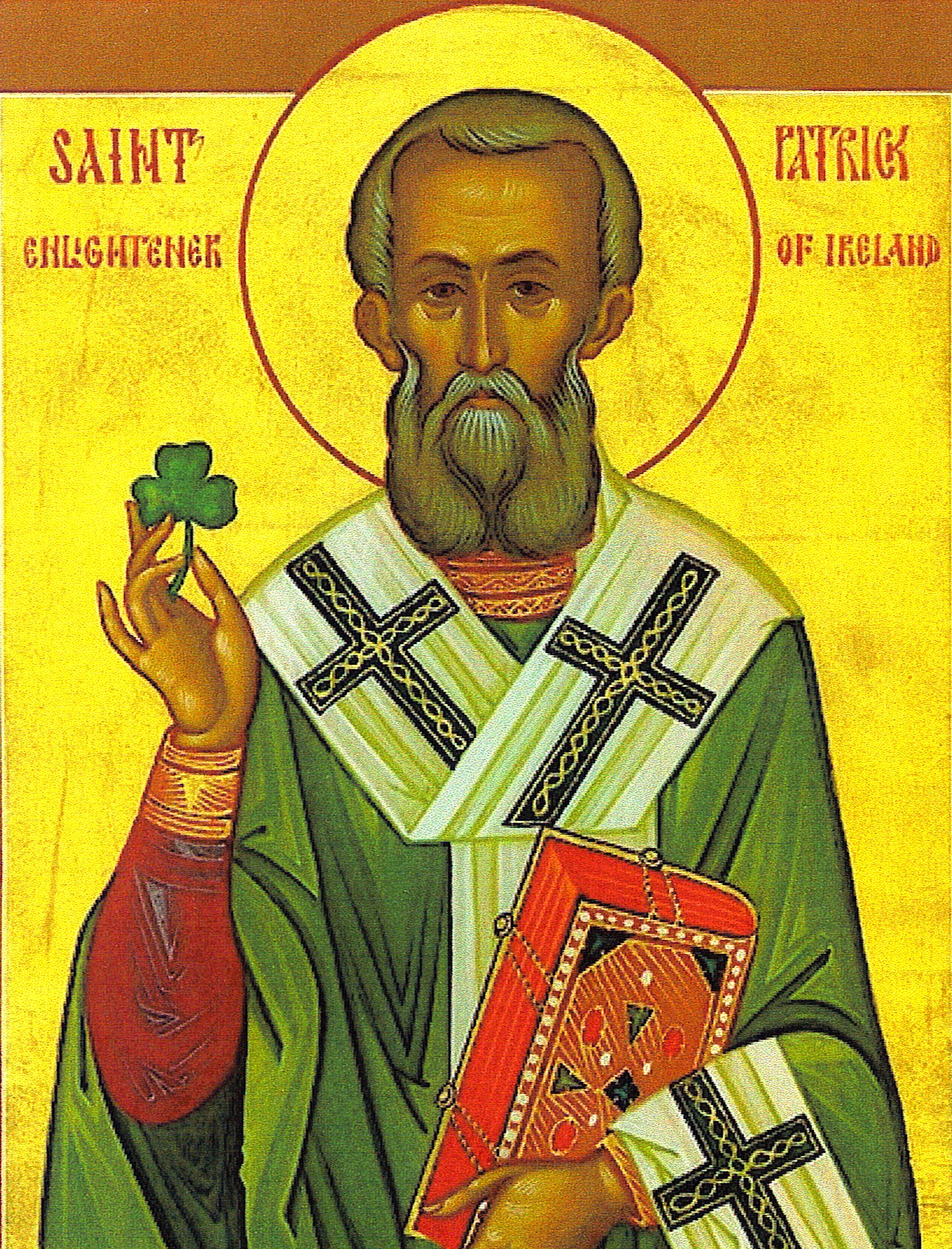
Icon of Saint Patrick in green holding a shamrock between his ring finger and thumb

Patrick’s Day isn’t about luck, green eggs and ham, leprechauns, or green clothes. So why do we have a day to celebrate this man called Saint Patrick?

Born in England, Patrick (whose name wasn’t Patrick in those days) was brought up in church. He came from a Christian family that taught him about God. When he was still just a boy, he was captured and taken to Ireland to a life of slavery. During his slavery, he grew close to God through prayer as he worked as a shepherd. After six year in slavery, he heard a voice telling him it was soon time to go home. The voice came again and told him his ship was ready. Patrick ran to the sea, 200 miles away, where he found a ship with a captain willing to take him home.

Once back in Britain, Patrick studied Christianity. He had a vision about the Irish people asking him to return. So Patrick went to Ireland as a Missionary. Patrick shared God with the people of Ireland. As a result of his ministry, Ireland came to know God. (They previously knew nothing of Christianity.)

So, why the green? And why the shamrock? Well, Ireland is a very green country. (See the picture below.) So, on St. Patrick’s Day, we wear green, the color of Ireland. Patrick used the shamrock to teach the Druids about God. Remember learning about the Trinity in earlier weeks? Patrick used the shamrock as an example to teach people the Triune Nature of God. God is 3 persons, 1 God. Just as a shamrock has 3 leaves, but is one shamrock.

Picture of a field in Ireland with green grass, a few green trees, green shrubs interrupted by a short rock wall.

Patrick is recognized as a Saint by many Christian traditions.

Do you think it was easy for Patrick to go back to where he had been a slave?

Coloring Page.

Lent Day 25: Cyril of Jerusalem: Feeding the Hungry

Small circular Ico on st. cyril of jerusalem dressed in blue with head covered and a scroll in his left hand.

Cyril was a theologian in the early Church. (around 313-386 AD) (Theology is the study of or how we think of God.) In 351, Cyril saw a cross of light in the sky over Golgotha. (Golgotha was the hill where Jesus was crucified.) The entire city of Jerusalem saw the cross in the sky.

When the city of Jerusalem went through a food shortage, Cyril started secretly selling some of the items from the church to pay for food to keep the people from starving. This wasn’t allowed. But Cyril did it anyway, choosing to break the rules rather than see his people suffer. He was charged and lost his job in the church because of this, but was later reinstated. Though he was exiled twice by Emperors.

Cyril also wrote many things about the nature of God and of forgiveness. “The Spirit comes gently and makes himself known by his fragrance. He is not felt as a burden for God is light, very light. Rays of light and knowledge stream before him as the Spirit approaches. The Spirit comes with the tenderness of a true friend to save, to heal, to teach, to counsel, to strengthen and to console.”

Are there hungry people where you live? What could you do to help feed them?

Coloring Page.

Lent Day 26: Joseph: Doing The Difficult Thing

Painting of Joseph holding baby Jesus with a red bracelet and a sprig of white Lillies.

Matthew 1:18-24 introduces us to Joseph.

This is how the birth of Jesus Christ took place. When Mary his mother was engaged to Joseph, before they were married, she became pregnant by the Holy Spirit. Joseph her husband was a righteous man. Because he didn’t want to humiliate her, he decided to call off their engagement quietly. As he was thinking about this, an angel from the Lord appeared to him in a dream and said, “Joseph son of David, don’t be afraid to take Mary as your wife, because the child she carries was conceived by the Holy Spirit. She will give birth to a son, and you will call him Jesus, because he will save his people from their sins.” Now all of this took place so that what the Lord had spoken through the prophet would be fulfilled:

Look! A virgin will become pregnant and give birth to a son,

And they will call him, Emmanuel.

(Emmanuel means “God with us.”)

 When Joseph woke up, he did just as an angel from God commanded and took Mary

as his wife.

This was definitely not the easiest path for Joseph to choose. He knew people would talk about he and Mary. He knew people wouldn’t understand what had happened. (After all, even he didn’t really believe it until an angel came and told him it was true!) But he chose to marry Mary and become Jesus’s earthly father. Joseph was the man who taught Jesus the things he needed to know to be a man. He taught Jesus scriptures and how to work with wood. Joseph cared for Jesus and protected him, as a father should. He didn’t have to, but he chose to.

Sometimes the things God asks us to do are not easy. Sometimes they make people think we’re weird, strange, or just unlikable. But God calls us to do it anyway. Joseph listened to God through the angel in his dream and ended up a part of the greatest story ever told. What will happen when you listen to God?

Coloring Page.

Coloring Page.

Lent Day 27: Francis of Assissi: Caring for God’s Creation

Drawing of St. Francis of Assisi with birds all around

It is only appropriate that we talk about Francis of Assissi during this Spring time of year!

Francis of Assissi was born in 1181. He was the son of a wealthy merchant, and spent much of his youth living a very materialistic (putting importance on having things, buying things, and spending money) life. He did not think of others and lived only for himself and his own fun.

In 1204, Francis went off to war as a soldier for Assissi. He had a vision there, and lost his desire for worldly things. When he returned home, he gave up his wealth and treasures, began preaching in the streets, and developed a following. He founded an order of monks, who lived with no worldly pleasures. Living a life caring for the poor, and also for animals and the world God had created, he saw the animals and plants as something good that God had created, and that we should take care of because it is from God. He often preached to animals.

When Francis died, it is said that birds came to be with him on his deathbed. Francis lived a simple life, but found that in the end, he was not alone. Many Christian traditions recognize Francis of Assissi as a Saint.

Activity: Enjoy the coming of Spring! God for a walk in nature and look at the things God created. You can also plant some seeds in honor of St. Francis today.

Coloring Page.

Lent Day 28: Elijah: Miracles, Even to The End

Painting of Elijah being brought bread by ravens next to a stream

Elijah was a prophet during the 9th century BC. Elijah lived a life of miracles. God gave him messages for the people, which he delivered. During famine and drought, God fed Elijah by having ravens bring him food. (1 Kings 17.) Elijah raised a boy from the dead. (1 Kings 17.) Elijah challenged the followers of a false God and showed the nation that there was One True God. (1 Kings 18.) God fed him yet again in the wilderness. (1 Kings 19.) Elijah heard the still, small voice of God in the wilderness. (1 Kings 19.) Elijah pointed out the wickedness people tried to hide. (1 Kings 21.) He called down fire from heaven. (2 Kings 1.) When it came time for Elijah to die, well, he didn’t. A fiery chariot with horses came and took Elijah to heaven in a windstorm. (1 Kings 2.)

So, what made Elijah so special? Why was he at the center of all these stories? The truth is, that Elijah wasn’t at the center of the stories. Elijah wasn’t the main character in his own life. God was. Elijah did what God said and went where God told him to go. God was at the center, and that is what made Elijah’s life such a whirlwind.

Who is at the center of your story?

When God tells you to go, will you go?

Coloring Page.

Coloring Page.

Click to see main 40 Holy People: A Lent Devotional for Families page.

Filed Under: Seasonal Devotionals Tagged With: faith, family, family devotional, family devotions, holy, homeschooling, inspiration, kid devotional, kids

40 Holy People: A Lent Devotional for Families: Week One

February 14, 2024 by notesfromtheparsonage 2 Comments

Stained Glass Swirl with Text 40 Holy People: A Lent Devotional for Families

This first week of Lent is a short week, beginning on Ash Wednesday. As we begin our family devotional, take note of the purpose of the season. Lent is a time of reflection, a time to recenter our lives. We look around, see what is necessary and what is extra. We give up some comforts and excesses. And we learn to thank God for enough. We deny ourselves and find we can see God a little more clearly. Each day brings us a little closer to the Cross. As we look at the lives of these extraordinary individuals, remember that, had they not focused on God, they wouldn’t be extraordinary. Extraordinary begins with steps outside the ordinary.

Lent Day One: John the Baptist — Preparing the Way of the Lord

Saint John the Baptist Icon image with scroll saying "repent for the Kingdom of Heaven is at Hand"

It is fitting that we begin this season of fasting with John the Baptist. Clothed in camel hair and eating locusts and honey in the wilderness, John the Baptist knew giving up worldly pleasures. John the Baptist was far from normal. His birth was foretold by angels. He was born to a barren couple and set aside from birth for a holy life. John was the one who prepared the way for Jesus. While still in the womb, he leapt at the presence of His Savior.

He was “the voice crying in the wilderness”. Can you imagine that being the thing said about you? He preached of the coming Savior, and crowds followed him. You can read about John’s ministry in Matthew 3, Mark 1, Luke 3, and John 1. Even after John baptized Jesus, he continued to be the wild-haired desert preacher. He made some people very uncomfortable, even made some mad, but he continued to spread the word he’d been given. John the Baptist spoke the truth, and that isn’t always easy for people to hear. In Matthew 14, we read of John’s death, which was far from pleasant.

What worldly pleasures will you give up during this season of Lent as you prepare for the Lord?

What truth has God given you to share? How can your life point more toward Christ?

Coloring Page

Coloring Page 2

Lent Day Two: Dietrich Bonhoeffer — Courage for the Sake of Others

black and white portrait of Dietrich Bonhoeffer

Dietrich Bonhoeffer was born February 4, 1906, in Germany. He was a pastor, theologian, and martyr. When the Nazis rose to power in Germany, Bonhoeffer spoke out against them.

At the urging of friends, Bonhoeffer left his home for the United States, to escape persecution by the Nazis. However, he soon regretted his decision and decided to go back home to his people and stand with them. 

“I have come to the conclusion that I made a mistake in coming to America. I must live through this difficult period in our national history with the people of Germany. I will have no right to participate in the reconstruction of Christian life in Germany after the war if I do not share the trials of this time with my people… Christians in Germany will have to face the terrible alternative of either willing the defeat of their nation in order that Christian civilization may survive or willing the victory of their nation and thereby destroying civilization. I know which of these alternatives I must choose, but I cannot make that choice from security.”

Dietrich Bonhoeffer

Bonhoeffer returned to Germany and continued to rebel against Nazi power, even helping in forming assassination attempts against Hitler.

On April 5, 1943, Bonhoeffer was arrested and imprisoned. In 1945, he was moved to a concentration camp. On April 9, 1945, two weeks before the United States liberated the camp he was in, Bonhoeffer was executed. “I saw Pastor Bonhoeffer… kneeling on the floor praying fervently to God. I was most deeply moved by the way this lovable man prayed, so devout and so certain that God heard his prayer. At the place of execution, he again said a short prayer and then climbed the few steps to the gallows, brave and composed. His death ensued after a few seconds. In the almost fifty years that I worked as a doctor, I have hardly ever seen a man die so entirely submissive to the will of God.” (Eberhard Bethge, witness to the execution)

Bonhoeffer could have easily stayed in America, safe from the evil on the other side of the world. Instead, he chose to stand up against evil– to stand with his people. He suffered for it, but ultimately, it was the right thing to do. He insisted, “Silence in the face of evil is itself evil: God will not hold us guiltless. Not to speak is to speak. Not to act is to act.”

“Being a Christian is less about cautiously avoiding sin than about courageously and actively doing God’s will.” (Eric Metaxas) [If you’re interested in learning more about the life of Dietrich Bonhoeffer, I recommend reading Eric Metaxas’ biography Bonhoeffer.]

Lent Day Three: Amy Carmichael — Showing the Love of Christ

Black and white picture pf Amy Carmichael with the children she ministered to

Amy Carmichael was born in 1867 in Ireland. She was the oldest of seven children. As a teenager, Amy started a Sunday morning group for mill girls which grew to over 500 participants.

Amy first became a missionary to Japan but fell ill and had to return home after 15 months. She then went to Ceylon and finally to India, where she found her life’s work.

She mainly worked with girls and young women who were forced into a kind of slavery to earn money for pagan temple priests. Children in India seemed drawn to Amy; when asked why, they would often say it was because of her love. Amy started a home for children in India, saving them from bleak futures in forced pagan temple service.

She rescued more than 1,000 children in India. Amy died in India at the age of 83. Instead of a headstone, the children she rescued put a bird bath over her grave and labeled it “Amma” (the Tamil word for ‘mother’).

“One can give without loving, but one cannot love without giving.”

-Amy Carmichael

“Give me the Love that leads the way
The Faith that nothing can dismay
The Hope no disappointments tire
The Passion that’ll burn like fire
Let me not sink to be a clod
Make me Thy fuel, Flame of God.”

-Amy Carmichael

How could you show others the love of God?

How have you felt the love of God through someone else?

Map of India

Optional Craft: Make a bird bath. Using a terra cotta pot and a pot base (or you could use a glass bowl), paint or decorate the pot, remembering that it will be used upside down. Glue the pot base or bowl onto the bottom of the terra cotta pot. If your pot base has a hole, you’ll want to take some caulk or putty and cover the hole. Once the putty is dry, fill your bird bath with some water and put it outside for the birds to enjoy.

Lent Day Four: Stephen — Love Your Enemies

The Martyrdom of Saint Stephen Icon Art depicting Saint Stephen praying while his accusers are gathering stones.

In Acts 7, we read about Stephen, who was the first person to die for His faith in Christ after Jesus himself died. Stephen proclaimed the Gospel to those who had persecuted Jesus. He wanted them to see that the Messiah had come. They were angry with Stephen for what he said. When they drug Stephen out of the city, Stephen looked into the Heavens and saw Jesus standing next to God the Father, and he told them what he saw. The elders became even angrier, refusing to listen. Instead, they picked up stones and stoned him to death. While Stephen was dying, he prayed that God would not hold his death against those who were killing him.

We easily say, “Love your enemies,” but do you think loving his enemies was easy to do in Stephen’s case? His enemies were killing him, yet he still showed love.

How can you show love to those who wrong you?

Coloring Page

Optional Craft: Get large river rocks and using paint or Sharpies, write on the rocks, “Love your enemies.” This craft is both a reminder of the love shown by Stephen and a reminder to love those who are against us. For younger kids, you may want to write on the rocks and then let them decorate with paint, stickers, or glued on gems.

Back to 40 Holy People: A Lent Devotional for Families.

Filed Under: Seasonal Devotionals Tagged With: children, Christian, devotional, faith, family devotional, family devotions, holy, inspiration, kid devotional, Lent

40 Holy People: A Lent Devotional for Families: Week Three

February 14, 2024 by notesfromtheparsonage 3 Comments

Stained Glass Swirl with Text 40 Holy People: A Lent Devotional for Families

This is the third week of our Lent Devotional for Families. We’re learning about holy people and opening our hearts to how God might make us holy, too. You can join from here, or you can go back to the beginning.

Stained Glass Swirl with Text 40 Holy People: A Lent Devotional for Families

Lent Day 11: Fanny Crosby — Using What I Have for God

Black and white image of Fanny Crosby wearing small glasses for the blind.

Fanny Crosby was born is 1820. Either she was blind from birth or she lost her sight shortly after.

At the age of eight, Fanny wrote her first poem. She was raised in a Christian home and by the age of fifteen had memorized the four Gospels, the Pentateuch, the book of Proverbs, the Song of Solomon, and many of the Psalms. She also learned to play the piano, organ, harp, and guitar.

In 1843, Fanny became the first woman to formally address the United States Senate. She advocated for the education of the blind.

Her first poem was published is 1841, and her first hymn was published in 1844. She continued to write hymns about her faith and country and poems about her convictions.

By the time she died in 1915, Fanny had written almost 9,000 hymns. Her goal was to win people to Christ through her songs. During the time of her hymn-writing, She lived in areas where she could help the poor and immigrants and was said to give away most of her money as soon as she got it. She kept only the money to pay for her basic necessities and gave away the rest to the poor around her.  Though she was blind, she used everything she had to point others to Jesus, whether in giving her money or time to help the poor or using her talents to write songs.

What do you do for God with what you have?

What could you do for others with what you have?

Activity: Listen to or sing one of Fanny’s hymns. (e.g., “All the Way My Savior Leads Me”, “Blessed Assurance”, “I Am Thine, O Lord”, “Jesus Is Tenderly Calling You Home”, “Near the Cross”, “Redeemed, How I Love to Proclaim It!”, “Rescue the Perishing”, “Take the World, but Give Me Jesus”, etc.)

“Blessed Assurance” sheet music — You can print this out for your kids to see what a hymn looks like in a hymnal. (Not all churches still have hymnals.)

Lent Day 12: John Wesley — Taking Jesus to the People

Portrait of John Wesley by George Romney. Painting of man with white hair and white collar.

Born in 1703, John Wesley was the fifteenth child (of nineteen). His mother, Susanna, taught the children to read, speak Latin and Greek, and memorize much of the New Testament. His mother was very devoted to helping her children develop a relationship with God.

In 1735, John and his brother Charles made the trip from their home in England to Savannah, Georgia. He spent a few years in Georgia as Savannah’s parish priest, gathered together many holy men and women, and grew the congregation.

Upon returning to England, Wesley began “taking church” to the people. He would preach in streets and where people were instead of waiting for them to come to church. John felt the need to go out and meet those who didn’t know God and introduce them. Traveling on horseback, he would preach two or three times a day. (To preach means to proclaim the Gospel, to tell people about Jesus.) Like Fanny, Wesley gave most of his money to the poor, keeping only what was necessary to meet his basic needs. He wrote books, peached sermons, met people where they were, and taught them about God and how to live a holy life.

Wesley died in 1791. His final words were, “Farewell, farewell. The best of all is, God with us.” He left 135,00 members and 541 preachers in the newly named “Methodist” churches.

“Do all the good you can. By all the means you can. In all the ways you can. In all the places you can. At all the times you can. To all the people you can. As long as ever you can.”

-John Wesley

Coloring Page

Lent Day 13: Helen Roseveare — Do Something for God

Picture of  Helen roseveare with child in her lap.

Helen Roseveare was born in England in 1925. As a child in Sunday School, she first felt she might be called to live on a foreign mission field. Her father thought highly of education, and Helen became a doctor. She still felt called to missions while in school and said, “I’ll go anywhere God wants me to, whatever the cost.”

After six and half years of medical school, six months in a missionary training center, and six months in Belgium studying French and tropical medicine, she went on a five-week trip to the Congo before she finally found herself where God was calling her. She was the only doctor for 2.5 million people. She began her work in a mud and thatch hospital while she built the building she needed and learned to speak Swahili. In eleven years, she had a 100-bed hospital and maternity complex and saved thousands of lives.

In 1964, Helen was taken as a prisoner of rebel forces in the area and endured beatings and torture. Once released, she returned to England to tell the people there that God’s grace had been sufficient during her time as a prisoner. She returned to the Congo in 1966 and continued her work helping the sick and injured until 1973. Helen is still alive today, writing books and encouraging people to be the hands of Jesus and do something for God.

“If I truly believe in Him, I’ll trust Him to desire for me that which is for my highest good and to have planned for its fulfillment.”

-Helen Roseveare

“It would seem that God had merely asked me to give Him my mind, my training, the ability that He has given me; to serve Him unquestioningly; and to leave with Him the consequences….How wonderful God is, and how foolish we are to argue with Him and not to trust Him wholly in every situation as we seek to serve Him!”

-Helen Roseveare

What do you think you could do for God now?

Use this map to color and find the Congo on the map.

Lent Day 14: Teresa of Avila — Visions of Castles

teresa of avila painting that looks like stained glass of woman in a habit infant of lilies and a dove

Teresa of Avila lived during the 1500s. (1515-1582, to be exact.) She lived in Spain and grew up in a family who converted to Christianity from Judaism. Teresa became a Carmelite nun early in adulthood. These nuns were devoted to prayer, though they were pretty lax about it when Teresa joined. Teresa worked to reform and strengthen her Cloister. (A cloister is a group of people living in a place of seclusion, much like a monastery.)

Teresa sought a deeper relationship with God through prayer and encouraged those around her to do the same. She had many visions during her quiet time with God. One of her visions was that of a castle. She described the spiritual life as walking through a castle, getting closer and closer to Christ who awaits us at the center.

“Let nothing disturb you.
Let nothing make you afraid.
All things are passing.
God alone never changes.
Patience gains all things.
If you have God you will want for nothing.
God alone suffices.”

-Teresa of Avila

“Christ has no body now but yours. No hands, no feet on earth but yours. Yours are the eyes through which he looks with compassion on this world. Yours are the feet with which he walks to do good. Yours are the hands through which he blesses all the world. Yours are the hands, yours are the feet, yours are the eyes– you are his body. Christ has no body now on earth but yours.”

-Teresa of Avila

Teresa of Avila is considered a Saint by many Christian Traditions. She devoted herself to prayer and to others finding a closer walk with God. Do you think you are devoted to prayer? Do you think you help others in their walk with God?

Coloring Page

Lent Day 15: Samuel Kaboo Morris — A Prince with a Mission

Black and white photo of Samuel morris in dark suit with white shirt

Samuel Kaboo was born in Liberia in 1873 as a prince among his tribe. When he was fourteen, he became a Christian; during that same year, he was captured by a neighboring tribe. He was beaten daily and was used as ransom to get his tribe to bring riches to his captors. One night, Kaboo saw a flash, and a voice told him to flee. His ropes fell off, he felt strong, and he ran off into the jungle, where he wandered for several days. He finally found a plantation and stayed there to work.

Samuel later felt called to America to learn more about God. He met a missionary who told him all she knew. He asked the missionary who taught her, and she gave him the name Stephen Merritt. Samuel walked to the shore and prayed that God would send a ship to take him to America. He eventually saw a trade ship and asked the captain to take him to America. The captain said, “No.” However, several of the workers on the ship ran away, so the captain asked Samuel to come on board to work. When he first boarded the ship, the other sailors abused him and made fun of Samuel, but by the time they reached America, they were all praying and singing hymns together.

In America, he found Stephen Merritt, who then asked Samuel to wait for him at his mission. When Mr. Merritt returned, he found that Samuel had begun a prayer meeting and had lead almost twenty men to Christ. He met many people and showed love and passion for Christ.

Samuel was used by God to draw many people to the Lord. While he attended school, many students came to pray with him. People from around the world would come to hear him speak. He inspired people to simply do something for God.

Samuel wanted to go back to Liberia and tell the people there about Jesus, but when he was twenty, he developed pneumonia. He prayed for God to heal him, but God told him that his work was done and that it was time to come home. Though other students encouraged him to pray and said that he needed to get better so that he could go back to Liberia and spread the Gospel, Samuel replied, “It is not my work… It is His. I have finished my job. He will send others better than I to do the work in Africa.”

After his death, many of his fellow students felt God calling them to go to Africa to be missionaries. Today, 85.6% of Liberians are Christian.

Do you pray for your neighbors? Your city? Your country?

Do you think God is calling you to share Him with your neighbors?

Use this map of Africa to color and find Liberia.

Lent Day 16: Perpetua — I Am a Christian!

Pixelated, cross-stitch image of Perpetua, a young girl with head tie and tunic with hands clasped in prayer

In 202 AD, Christianity was illegal. Perpetua was a Christian. Perpetua was arrested as she was preparing for Baptism. Her father, a nobleman, asked her to say she was not a Christian so she would not be put to death. She replied, “Could this vase of water be called any name other than what it is?” Her father said it could not. She replied, “Well, so too I cannot be called anything other than what I am– a Christian.”

At first, Perpetua was held under house-arrest. She was baptized in the house while under arrest. Then, she and her fellow Christians were then moved to a prison and locked in a dungeon. Eventually, she was moved to a better part of the prison where she could receive visitors. Perpetua was sentenced to death in an amphitheater. She told those with her, “You must all stand fast in the faith and love of one another, and do not be weakened by what we have gone through.”

Before her death, Perpetua asked God for a vision, showing if she would be condemned or freed. Perpetua received this vision from God: She saw a narrow ladder reaching to heaven, but only one person could climb up at a time. She saw a garden with a man dressed as a shepherd at the top of the ladder. Around the shepherd were thousands of people dressed in white. When the shepherd looked up and saw her, he said, “I am glad you have come my child.”

Perpetua and another young woman who was martyred with her, Felicitas, are recognized as Saints by many Christian traditions.

Coloring Page

Coloring Page 2

Click to see main 40 Holy People: A Lent Devotional for Families page.

Filed Under: Seasonal Devotionals Tagged With: devotional, faith, family, family devotional, family devotions, holy, inspiration, kid devotional

  • « Go to Previous Page
  • Page 1
  • Page 2
  • Page 3
  • Page 4
  • Page 5
  • Interim pages omitted …
  • Page 12
  • Go to Next Page »

Primary Sidebar

Hello there!

black and white image of lady with long dark hair and glasses next to window with bamboo window shade

I’m Lindsey Jane, wife of a pastor and mama of 9 (yep, 9). Read along as I write about faith and family!  You can read more about our family and me here.

Try Audible Plus Today!

Listen to my recommended book this month with an Audible subscription today! (Use these links to support this website!)

NLT Thinline Reference Bible Review

The Pastor decided he wanted to read the New Living Translation of the Bible this year. This is a “thought for thought” translation, which differs from the English Standard Version he usually reads, which is more “word for word”. I have accidentally created a Bible snob, so when he said he needed a physical copy…

Read More

Books I’m Reading in 2026

I’ve put together my reading list for 2026. I’m not going to share every single book, but you can always follow me on Goodreads if you want updates on all of it. I’m going to admit, I’ve chosen more books than I think I can read– but onward we go anyway! Non-Fiction Reading for 2026…

Read More

Books You Should Consider Reading in 2026

It is that time of year that we make a list of the books we want to read in the coming year. What should make your list in 2026? I have a few suggestions for you to consider. Non-Fiction Books to Read in 2026 No More Boring Bible Study by Faith Womack I read this…

Read More

Moment By Moment

Pinterest image of title of this blog, moment by moment, on blue background above an image of stained glass showing a pillar of cloud and fire

Let me set the scene, the Israelites (possibly numbering more than 2 million at this point in time) have been driven from Egypt after the ten plagues and they’ve entered the wilderness and have no idea where they are going. God knows the weakness of the people, so He is taking them the long way…

Read More

Copyright © 2026 Notes From the Parsonage on the Foodie Pro Theme