• Skip to primary navigation
  • Skip to main content
  • Skip to primary sidebar
Notes From the Parsonage
  • About Us
    • Privacy Policy
  • Faith
    • Encouragement
    • Bible Reviews
    • Seasonal Devotionals
    • Topical Devotionals
  • Family
    • Kid Product Reviews
    • Mama
    • Crafts
  • Homeschool
    • Morning Basket
    • Bible Classes
  • Table
    • Kitchen Product Reviews
    • Recipes
      • Desserts
      • Large Family Meals

Godbold Academy 2020-2021: Logic Stage Plans

February 2, 2020 by notesfromtheparsonage 1 Comment

The logic stage in homeschooling lasts from about fifth or sixth grade through eighth grade, depending on the child. This is what we’d all typically call “middle school”. The logic stage is a bump up in difficulty, and I expect my logic aged children to be pretty much independent. I do not read the scheduled books to my logic students, they read all their books on their own except for Morning Basket. For the logic stage, I give the child a list of the work they need to do each day and they check it off as they complete it. I do check it at the end of the day or week, depending on the child. And we do discuss it, usually over dinner.

Bible

Herein is Love: Numbers (weeks 1-24)

Herein is Love: Deuteronomy (weeks 25-34)

History

Story of the World, Volume 1 (weeks 1-34)(This is the history spine for both the grammar and logic stages. If you have grammar aged kids and are reading the chapter to them, you can include the logic student in the reading. Logic students keep a list of the important people and dates from this reading. I plan 1-2 chapters each week to complete the entire volume in three 12-week terms.)

Story of the World, Volume 1, Activity Guide (weeks 1-34) (This activity guide has questions about each chapter and outlines to complete, along with activities and book suggestions should you choose to do them.)

Book of the Ancient World with Memoria Press Study Guide (2-3 days/week; weeks 1-12)

Famous Men of Greece with Memoria Press Study Guide (1-2 days/week; weeks 1-20)

Book of the Ancient Greeks with Memoria Press Study Guide (2-3 days/week; weeks 13-23)

Famous Men of Rome with Memoria Press Study Guide (1-2 days/week; weeks 21-35)

Augustus Caesar’s World (3-5 days/week; weeks 23-36)

Science

Nature Study: The Laws Guide to Nature Drawing and Journaling (weeks 1-36)

Core: General Science 2: Survey of Archaeology and Geology (weeks 1-36)

Language Arts

Grammar: Easy Grammar Plus (5 days/week; weeks 1-36)

Writing: The Creative Writer (weeks 1-36)

Literature

The Hobbit with Memoria Press Study Guide (weeks 1-10)

The Lightening Thief (weeks 1-11)

Imagine… The Great Flood (weeks 1-15)

The Bronze Bow with Memoria Press Study Guide (weeks 13-21)

The Sea of Monsters (weeks 13-22)

Imagine… The Ten Plagues (weeks 16-30)

The Children’s Homer (weeks 22-32)

The Titan’s Curse (weeks 23-36)

Logic

The Thinking Toolbox (2 days/week; weeks 1-19)

The Fallacy Detective (2 days/week; weeks 19-36)

Languages

Latin: Canon Press Latin Primer (weeks 1-36)

French: Rosetta Stone French (2-3 days/week; weeks 1-36)

Math

Strayer Upton Arithmetics (5 days/ weeks; weeks 1-36) (Book: 1, 2, 3)

Character

The Radical Book for Kids (1-2 days/week; weeks 1-35)

I keep everything planned out as seen above for each week. For the grammar stage, I try to plan the majority of the work Monday-Thursday and add extra subjects in on Fridays.

** This post contains affiliate links. Using affiliate links is a great way to support your favorite content creators. **

I encourage you, don’t feel like you have to buy all your school books new! Check out ThriftBooks.com for some great deals on used books. (That link is my referral link!) Also, check out Scribd, which is like Netflix for ebooks and audiobooks. (That link is my referral link!) There are so many great books available through both that will save you money. Also, remember to check your library. Libby is a great app that many library systems use where you can get ebooks and audiobooks through your local library. Of course, you can also max out your library card checking out great books, as well.

Filed Under: Homeschool Tagged With: classical education, classical homeschooling, curriculum, free, free curriculum, free homeschool curriculum, homeschool, homeschool curriculum, homeschooling, logic stage, middle school

Godbold Academy 2020-2021: Grammar Stage Plans

February 2, 2020 by notesfromtheparsonage 1 Comment

The grammar stage in homeschooling spans from about kindergarten or first grade through fourth or fifth grade, depending on the child. I include my young ones in our grammar schooling, as they usually want to keep up with their siblings and they enjoy the readings and such. Some things are specific to the actual place the child is in a subject, some things are more universal. If you’ve never seen planning by stage, this may seem confusing that first and fifth graders can go by the same curriculum plans. But trust me, I’ve been combining ages for a long time and can tell you, even with the same sources, kids work and understand at the level they are.

Bible

The Ark, The Reed, and The Fire Cloud (4 days/week; weeks 1-17)

The Dreamer, The Schemer, and The Robe (4 days/week; weeks 18-32)

History

Story of the World, Volume 1 (1-2 days/week; weeks 1-34) (This is the history spine. There are additional readings for history, but this is the main portion of history. I cover 1-2 chapter each week to get through the entire volume in our three 12-week terms.)

Story of the World, Volume 1, Activity Guide (weeks 1-34) (This book is used for weekly activities and contains coloring pages and suggestions to “beef up” Story of the World.)

It’s Disgusting and We Ate It! (week 1)

You Wouldn’t Want to be a Pyramid Builder (weeks 2-3)

You Wouldn’t Want to be a Sumerian Slave (weeks 4-5)

Gilgamesh the King (week 6)

The Revenge of Ishtar (week 6)

The Last Quest of Gilgamesh (week 6)

One Grain of Rice (week 7)

The Story About Ping (week 7)

Anasi the Spider (week 8)

Temple Cat (week 8)

Baby Moses (week 9)

In Search of a Homeland (weeks 9-14)

Tales of Troy and Greece (weeks 13-20)

D’Aulaires’ Book of Greek Myths (weeks 21-36)

Classical Kids (activity guide for making history activities)

Old Testament Days (activity guide for making history activities)

Science

Nature Study: Christian Liberty Press Nature Reader on Student’s Level (1-3 days/week; weeks 1-36)(individual readers availble for sale on Christian Book)

Core Science: General Science 2: Survey of Geology and Archaeology (just using the books for the grammar stage. The logic and rhetoric stages are using the full curriculum. This is our main science curriculum. We’re adding some more books to further study the topics found in these books.) (weeks 1-32) (Individual books: Archaeology, Geology, Fossil, Cave)

Geology Lab for Kids (weeks 33-36)

Rocks, Rivers, and the Changing Earth (weeks 1-28)

Archaeologists Dig for Clues (weeks 1-2)

The Street Beneath My Feet (weeks 3-4)

What is an Archaeologist? (weeks 5-6)

Ancient Civilizations (weeks 7-10)

Planet Earth Inside Out (Week 11)

Rocks, Fossils, and Arrowheads (week 17)

A Rock is Lively (week 19)

Rock Collecting for Kids (weeks 20-21; 28-32)

Caves and Caverns (weeks 22-25)

Jurassic Poop (week 26)

Let’s Go Rock Collecting (week 27)

Language Arts

Once kids can read, they start grammar. I do read the Literature books out loud for the younger kids. Free Reads are for kids old enough to read chapter books alone. If you’ve got a great reader, check out the books for the logic stage. If you’ve got ones learning to read, reading Bob books during the free reading time is a great option.

Grammar

Beowulf Grammar (4-5 days/week; weeks 1-36)

Literature Reads

The First Dog (week 1)

A Cry from Egypt (weeks 1-8)

Mummies Made in Egypt (week 3)

Mummies in the Morning (weeks 4-8)

Hour of the Olympics (weeks 9-12)

The Children’s Homer (weeks 13-20)

The Trojan Horse (weeks 15-18)

Romulus and Remus (weeks 21-22)

Aesop’s Fables (weeks 22-36)

Free Reads

The Mouse and the Motorcycle

Runaway Ralph

Ralph S. Mouse

Fortunately, the Milk

The Fantastic Mr. Fox

James and the Giant Peach

The Boxcar Children

Handwriting

Draw, Write, Now (1-2 days/week; weeks 1-36)

Logic

Creative Problem Solving (1 day/week; weeks 1-36)

Languages

My kids have been learning French. I usually don’t start Latin until the Logic stage.

My First French Lesson (1 day/week; weeks 1-36)

Math

Use whatever math works for your child. This is just what we use for this stage.

Math Mammoth on child’s level (4-5 days/week; weeks 1-36)

Character

The Mess Detectives and the Case of the Lost Temper (week 10)

Junior Comes Clean (week 11)

Bob and Larry and the Case of the Missing Patience (week 12)

Larry Makes a Choice (week 23)

All is Fair When We Share (week 24)

I keep everything planned out as seen above for each week. For the grammar stage, I try to plan the majority of the work Monday-Thursday and add extra subjects in on Fridays.

** This post contains affiliate links. Using affiliate links is a great way to support your favorite content creators. **

I encourage you, don’t feel like you have to buy all your school books new! Check out ThriftBooks.com for some great deals on used books. (That link is my referral link!) Also, check out Scribd, which is like Netflix for ebooks and audiobooks. (That link is my referral link!) There are so many great books available through both that will save you money. Also, remember to check your library. Libby is a great app that many library systems use where you can get ebooks and audiobooks through your local library. Of course, you can also max out your library card checking out great books, as well.

Filed Under: Homeschool Tagged With: classical education, classical homeschooling, curriculum, free, free curriculum, free homeschool curriculum, grammar stage, homeschool, homeschool curriculum, homeschooling, plans

Godbold Academy 2020-2021: Morning Basket

February 2, 2020 by notesfromtheparsonage 5 Comments

I mentioned in my review of A Gentle Feast that we aren’t going back to it this coming school year. I figured I’d share our full curriculum plans for this coming year, which include all three classical stages or all four Charlotte Mason forms, whichever way you want to look at it. We’ve got a lot of kids spanning a lot of grades around here. Our history cycle this coming year will be Ancient History, which I’m pretty excited to get back into. For the sake of length, I’m splitting the posts on the curriculum up, so be sure to check out the Grammar (K-4/5), Logic (5/6-8), and Rhetoric (9-12) plans, as well.

Morning Basket

I like to start the day with all the kids together. We will add poetry memorization and Bible verse memorization to this book list. I’ll choose one poem per kid/stage and one Bible passage for all the kids for each of the three terms. All weeks are approximate, as sometimes we read faster and sometimes we read slower. I should also note that this is not the entirety the kids will learn in these subjects, just what we are reading together.

Bible

I Am: 40 Reasons to Trust God (3 days/week; weeks 1-14)

I Am Devotional: 100 Devotions About the Names of God (3 days/week; weeks 14-36)

Action Bible Guess-It Game (1 day/week; weeks 1-12)

Apples to Apples Bible Edition (1 day/week; weeks 13-36)

Character

I am N (2 days/week; weeks 1-36)

Manners

Emily Post’s Etiquette (1 day/week; weeks 1-36)

History

Unveiling the Kings of Israel (1 day/week; weeks 1-20)

Unwrapping the Pharaohs (1 day/week; weeks 8-36)

Science

The Great Dinosaur Mystery and the Bible (1 day/week; weeks 1-7)

Dinosaurs: Marvels of God’s Design (1 day/week; weeks 8-36)

Read Alouds/ Literature

The Mysterious Benedict Society (4-5 days/week; weeks 1-12)

Nooks and Crannies (4-5 days/week; weeks 13-24)

Wonder (4-5 days/week; weeks 25-36)

Fun

Mad Libs (1 day/week; weeks 1-36) (We usually got through 3-4 Mad Libs books per year. I generally grab ones I think the kids will enjoy, since it is for fun. It does help, especially with the younger ones, to learn the parts of speech.)

Mother Culture

This year, I’m adding the category of Mother Culture to my Morning Basket. These aren’t books I’ll be reading with the kids, they are books I’m assigning myself to read to grow and expand. Your choices for this may vary, and your reading speed may vary. I wanted some homeschool encouragement, but feel like I need a lot of mom encouragment this year. You might find you want something different. Choosing the books ahead of time keeps me from making excuses not to do it and it sets a path forward for me. For me, a book a month is a fairly leisurely speed that will allow for other reading as it comes, as well.

The Brave Learner

The Ministry of Ordinary Places

Theology of Home

Mere Motherhood

The Life-giving Home

Why Motherhood Matters

The Call of the Wild and Free

Mama Bear Apologetics

A Mother’s Rule of Life

Extras

These are extra things I keep on hand for after school play or during reading quiet play for the littler ones.

Imhotep Board Game

Temple Trap Game

Zeus on the Loose Game

Greek Gods and Goddesses Coloring Book

Life in Ancient Egypt Coloring Book

Dinosaur Coloring Book

Ancient Rome Toob

Ancient Egypt Toob

Mythical Realms Toob

Greek Mythology Top Trumps

Ancient Egypt Top Trumps

Heir of Egypt Game

Alphabetimals Coloring Book

Animal Alphabet Coloring Book

Sea Life Alphabet Coloring Book

I set up a chart for each week that looks similar to this. I haven’t chosen the specific poems or memory verses just yet, so I’ll fill that in once I decide. If I’ve already printed it, I’ll just write that in. I’ll print these out and put them in a binder with our Morning Basket of books.

** This post contains affiliate links. Using affiliate links is a great way to support your favorite content creators. **

I encourage you, don’t feel like you have to buy all your school books new! Check out ThriftBooks.com for some great deals on used books. (That link is my referral link!) Also, check out Scribd, which is like Netflix for ebooks and audiobooks. (That link is my referral link!) There are so many great books available through both that will save you money. Also, remember to check your library. Libby is a great app that many library systems use where you can get ebooks and audiobooks through your local library. Of course, you can also max out your library card checking out great books, as well.

Filed Under: Morning Basket Tagged With: Charlotte mason, classical homeschooling, free curriculum, free homeschool curriculum, free morning basket plans, homeschool, homeschool curriculum, homeschooling, homeschooling large family, homeschooling many ages at once, morning basket, morning basket plans

ESV Illuminated Scripture Journal Review

December 31, 2019 by notesfromtheparsonage 2 Comments

Collage image of ESV Illuminated Scripture Journals with text "ESV Illuminated Scripture Journal Review".

The Scripture Journal is a great new Bible study tool that I think you’ll love! Each book of the Bible is broken down into its own little notebook with plenty of room for notes and doodles. Your inductive Bible study experience will never be the same!

At the end of last year, I was able to review Crossway’s Illuminated Scripture Journal New Testament set. It is such a beautiful set and I have enjoyed it this year. Crossway released the Illuminated Scripture Journal Old Testament set earlier this year, and I knew it’d be just as lovely as the New Testament set. What I was not expecting was the sheer size of the thing.

Illuminated Scripture Journal Old and New Testament box sets on blue wood table

I mean, clearly, I was aware that the Old Testament is larger than the New Testament. But seeing it like this made it very vividly clear just how much bigger the Old Testament really is.

Looking at them side-by-side is a bit mind blowing.

Thick Scripture Journal book compared to thin Scripture Journal book

Clearly, some of the books are massively thick and others are pretty thin. The thinner books have some extra blank pages in the back of them.

Spines of Scripture Journal prophet books up close

The minor prophets are combined, so there isn’t a book for each one. Additionally, books with a first and second (Kings, Chronicles) are combined.

A Look Inside the Scripture Journal

Scripture Journal open on table to reveal Scripture on one side and blank paper on the other side.

Just like the New Testament set, you have the words of Scripture on the left hand page and a faint dot grid on the right hand page.

Picture of gilded Bible verse printed on dot grid paper

Illustrations appear throughout. Some take up an entire page and are on the left side. If they are small, they are on the right hand dot grid page.

Scripture Journals and Bible Journaling

Warping of paper with watercolor use. Minimal page warping with watercolor colored pencil use.

If you’re curious how different media work with the paper, here are some examples from my Romans book. Our church had a small group on Romans, so I used my Illuminated Scripture Journal for that small group. The left page (above) has been watercolored on the back side of the page. There is some wrinkling, but no bleed through. The right illustration is watercolor colored pencil and micron pen, neither of which showed through or warped the paper much.

Scripture Journal opened. Scripture on left is highlighted. Happy cactus illustration in marker on the right hand side of page.

This page has Stabilo marker and Micron pens and it didn’t bleed through or warp the paper at all. The paper is much thicker than a standard Bible paper. It feels more like a Moleskin Cahier paper.

Do I Recommend the Illuminated Scripture Journals?

Close up of the box lid of the Illuminated Scripture Journal Old Testament set.

Yes! The entire set is just beautiful and well-worth the buy, in my opinion. I really enjoyed using these for Bible study. It was super convenient to be able to throw my Bible study book and the book of the Bible we were studying in my purse to read whenever I had the chance. I also really enjoyed taking notes and illustrating throughout the book. These are very much like my favorite journaling Bible, the Crossway Interleaved Journaling Bible. The paper is much thicker, and it isn’t quite interleaved, but the effect is very similar.

This set is perfect for inductive Bible study. You’ll have just the one book of Scripture and can highlight and take notes without feeling like you’re ruining your Bible.

These are also excellent when your pastor is preaching through a sermon series on a specific book of the Bible. Or when your small group is doing an Isaiah study– or whatever book they’ve chosen. It is just so convenient to have just the one small notebook sized book.

You can also purchase just a single Scripture Journal and not the whole set. So if you’re just wanting to deep dive into the Psalms– you can purchase just the Psalms Scripture Journal.

Spines of the Illuminated Scripture Journal Old Testament set in the box on a blue table

It is very large and takes up quite a bit of shelf space. I happen to think it is beautiful and looks lovely set out, so I don’t mind the size so much. I like both sets so much and am very glad to have both.

Collage image of ESV Illuminated Scripture Journals with text "ESV Illuminated Scripture Journal Review".

You can also put the Scripture Journals into a traveler’s notebook while you’re using them. They’re the perfect size and that gives it a little more of a “cover” to protect it.

Covers of two Scripture Journals- blue gilded notebooks on a blue table

Other Notes From the Parsonage Posts You Might Enjoy

  • ESV Interleaved Journaling Bible
  • ESV Personal Study Bible Review
  • She Reads Truth Review
  • Heirloom Study Bible Review
  • ESV Pocket Bible Review

**This post contains affilaite links. Affiliate links do not cost you more to use, but they do benefit your favorite content creators. **

Filed Under: Bible Reviews Tagged With: Bible, bible journaling, bible review, bible study, bibles, crossway, crossway Bible, illuminated, illuminated bible, journaling bible

Good Enough Parenting

June 13, 2019 by notesfromtheparsonage 2 Comments

If you follow me, you’ll know that I have made the foolhardy decision to go back to school. Because, you know, homeschooling seven kids and being in full-time ministry isn’t enough on a person. I clearly lacked the pressure of deadlines and lamenting over formatting issues in the wee hours of the morning in case my toddler isn’t keeping me up enough. Smack dab in the middle of my struggle to be everything to everyone, I get to take a lifespan development class. Now, I was really not looking forward to knowing all the ways I was currently messing up my kids’ lives. I’d really rather just keep my head down and get through this degree program.

And right on schedule, as I dove into lifespan development for the third time (I’ve had lifespan development classes before from other perspectives), I was ready to feel bad about the stress I am putting my family under right now. At first, I got that— the guilt. Infants rely on the steady care of a single caregiver and are upset when that is disrupted. Sorry Daisy. Preschoolers need adequate scaffolding to help them acquire new and deeper skills. Sorry Pippin, can’t scaffold for you, Mama’s got to write a paper about it instead. School aged children need security and patience with close monitoring as they learn new skills and begin to see themselves as others see them. Sorry Topher and Ransom, I don’t have time to monitor your mud pit fun, I’ve got papers to write. You get the idea. Everything is a slap in the face when you feel like you’re messing everything up— especially when you’re a mom of seven in school full time.

Then I came across the work of Donald Winnicott. He was an English pediatrician and psychoanalyst who voiced the idea of the “good enough” parent. I’m going to be grossly simplifying his work and pretty much just talking about a singular aspect. I’m imagining that if you were especially fond of psychoanalytic theory of infant development, you’d likely be taking the class I’m taking or reading a much longer book about the topic. (And just as a point of interest, the class ended up being extremely interesting and insightful. I feel like I only scratched the surface and would need another year to follow all the little rabbit trails my brain made.) For Winnicott, children didn’t need perfect parents. Children needed someone they could count on, but that someone didn’t have to be perfect all the time, they just had to be good enough. They just had to show up, love the kid, and do their best. Winnicott said that was the best kind of parent.

In today’s “perfect parenting” world, where parents feel judged every time they turn around, a world where parents spend so much time comparing their own parenting (and life) to what they see on Instagram, it is a breath of fresh air to read an expert tell us we only need to be “good enough”. The idea that everything bad that happens to our kid will be our fault is never flipped. If I’m responsible for all wrong roads my child may take, I’m also responsible for the right ones. And really, according to Winnicott, if I show up and do my best, my kids will turn out fine. Winnicott realized something our society won’t mention. Moms are people. They come with their own burdens, insecurities, and issues. Learning to be there for a child while still being a real person isn’t the easiest task for some people. And if you’re showing up, trying your best, and meeting the kid’s needs most of the time— you’re doing a good enough job of it. Not all of us can be Instagram perfect. We can’t have the perfect house with everything in various shades of white and grey. (How do you people keep white couches clean with kids?!) We can’t all be stay at home moms with endless budgets for all the kids enrichment activities and the “right” toys, clothes, and baby gear. We can’t all have all organic everything from the local farmer’s market. Life is messy. Life isn’t always ideal. The good news, according to Winnicott, is that we don’t need all those things. We need to pay attention most of the time. We need to provide security most of the time. We need need to learn to sacrifice, but it is okay for life to not be all sacrifice. We won’t get the mothering thing right every single time. The good enough mom knows this and can give herself some grace, learn from her mistakes, and move on. 

So if I have to delegate some schooling tasks to Dad for the next year, that is okay. If afternoon reading time has to be audible books, that is okay. If my cooking slips to eating PB&J a little too often, they will survive. If I’m not sewing them cute clothes and instead slipping them into hand-me-downs, I doubt they’ll notice. I’m here. I’m doing my best. The kids will be alright, I’m good enough. 

Filed Under: Uncategorized Tagged With: child development, encouragement, good enough mother, inspiration, lifespan development, motherhood, mothering, mothers, parenting, psychology, raising kids, winnicott

Crossway Heirloom Study Bible Review

March 7, 2019 by notesfromtheparsonage 4 Comments

The pictures of this Bible aren’t going to do it justice. You really have to hold this Bible in your hands to appreciate it fully. I’m pretty much going to let the photos do most of the talking. This is the ESV Heirloom Bible by Crossway. The cover is goatskin. It has four (!) ribbon markers. There are so many extras in this Bible. It is pretty big. This is not a compact Bible by any means. This is the big, fat Bible of your grandparents. And this one will last that long, too.

This is a study Bible. It has so many maps, charts, articles, and features. It is amazingly packed full of anything they could think of that would help you better understand the Word of God. The articles and insights are thoroughly Biblical. If you’re more liberal leaning, this will likely not make you very happy.

When I said packed with extras, I really meant it. It is PACKED with extras. The Pastor has been using this Bible as a preaching Bible for a few months now. (His preaching Bible fell apart at the end of last year. He preached the cover right off!) While this Bible is a bit large and weighty for a preaching Bible, I highly recommend anyone in the ministry to get a high-quality Bible like this one that won’t fall apart on you with excessive use.

** I was sent this Bible for no cost. I do use affiliate links to help support this blog.**

Filed Under: Uncategorized Tagged With: bible review, crossway Bible, esv, esv bible, goatskin bible, heirloom bible, study bible

2017-2018 Morning Basket Curriculum Review

May 14, 2018 by notesfromtheparsonage Leave a Comment

You can find the post of my plans here. This was my first year incorporating a morning basket into our homeschool routine. It was something I picked up from Charlotte Mason homeschoolers. And while we generally stick to The Well Trained Mind, morning basket sounded like something I wanted to adapt to our homeschool routine.

img_1639-2

This school year, I had a wide range of ages. And from here until people start graduating, the range will continue to expand. I really wanted something to keep them all together while they are all going their own ways. That makes no sense, but maybe you follow. I ended up not getting as much covered as I expected. I did not account for how much time would be spent either reading with a distracting toddler or while trying to nurse a new baby. I was pretty okay with relaxing my standards a bit. So, some books I planned to read didn’t get touched.

History

We are sticking with The Story of The World for history. Younger kids jump in wherever we happen to be in the history cycle. This year, we were on Year 3. I read a chapter once or twice a week during morning basket. We actually ended up finishing it in term 2, so term 3, we went back and read some supplemental materials we didn’t get around to in the first pass instead of proceeding on to Year 4.

I used The Activity Guide, The Well Trained Mind, and Ambleside to make up our supplemental reading list. I will get into the grade specific supplements in later posts. For this post, I’m just focusing on the ones we used in our Morning Basket.

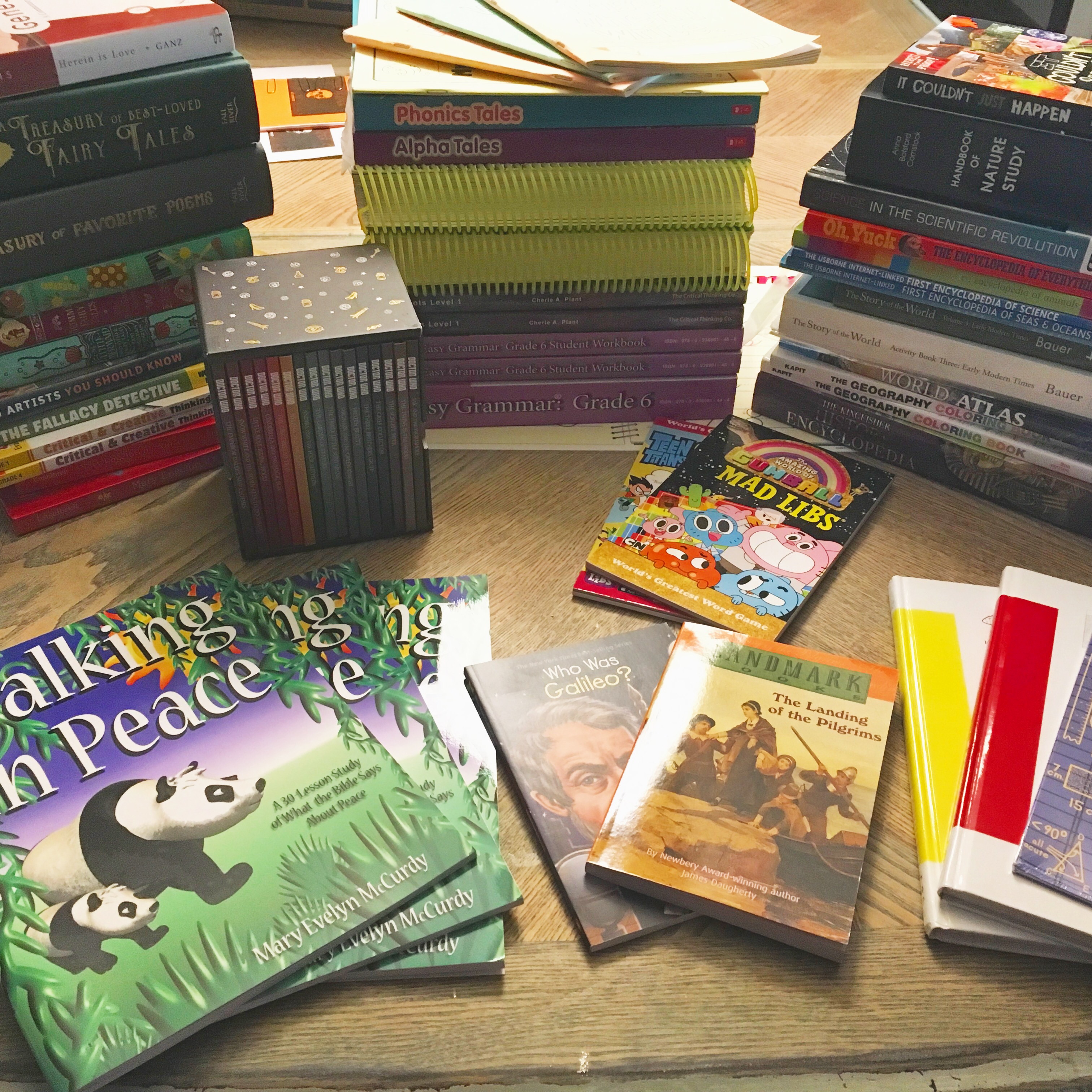
The Landing of the Pilgrims was a bit dry, but it did give a good picture of what was going on with the pilgrims as they settled North America. Diving into this gave a better picture of how America was built with certain aspects of life in place. It gave a better understanding of what “religious freedom” would have meant to these people. The kids recalled the details of the book really well, despite only listening to me read it. It ended up taking up an entire term to read this because of the whole having a baby thing.

George Vs. George is a picture book with lots of information. We actually spread this out over a week of reading. My older kids were later found rereading it in their own time. Apparently they liked it.

Can’t You Make Them Behave, King George? is another info packed picture book. The kids really enjoyed it.

If You Can Keep It is not a book written for children. It is a very interesting read. It pretty much went over the heads of the younger crew, but the older three did seem to understand much of what we read and it lead to some very interesting dinner table discussions about liberty, freedom, and religion. It made a good read aloud supplement to the American Revolution for my logic aged kids. It would make a good independent reading book in the rhetoric stage. It deals with lofty topics, but it written in a very approachable way.

John Wesley: The World and His Parish was an excellent read. Anyone in the Wesleyan tradition should read this to their kids. It is a bit on the dry side, but it is really interesting. It doesn’t sugar coat the situation at all. You’ll better understand Wesley’s ideas and intentions through reading about his life. This probably falls more in line with character development than history, but we ended up having a good bit of cross over with John Wesley’s world our history studies.

Operation World was again a big part of our geography studies. We focused in on the Caribbean islands this year since The Pastor made his first trip down to Haiti to teach at a seminary there. We also read Under The Storyteller’s Spell, which is a collection of Caribbean folk tales. We found them pretty interesting and they sparked discussions of the culture of these people. It ended up overlapping into history as we were talking about the slave trade and the revolutions of South America and the Caribbean islands a bit.

Science

We started the year using the Berean Builder‘s curriculum.  But really, I couldn’t keep up with the experiments with a newborn, so we had to switch gears a little bit.

It Couldn’t Just Happen ended up taking most of the year to get through. It wasn’t the length or difficulty so much as I didn’t want to throw too much out at once. I felt like taking it slower gave them more time to process the information. This book is essentially answering the question, “Did the universe and all that is in it just happen or is their a Creator?” The book is not dogmatic about creationist issues (literal 7 days, young earth/old earth, etc.) It simply points out the evidence that supports that there is an intelligent design to our world. It is an argument against Darwin’s Theory of Evolution. It does allow for natural evolution, but not the Theory of Evolution. It is a very interesting look into the scientific process and about how we “know” something to be scientifically true, only to find out later it isn’t as true as we thought. Science exists in theories, so we have to have some flexible system of working through the evidence as it arises. My 10 year old said this was his favorite part of the school day.

We also read excerpts from The Handbook of Nature Study. We also grabbed up library books to explore topics as they came up. When talking about the gold rush in history, the topic of gold and geology arose, so we investigated it through library books.

Prayer

I had this plan of the prayers we would learn as a family. I picked too many. I picked 3 prayers per term, meaning we’d learn one prayer each month. At the end of the month, they were just getting to the place of memorization of the prayer. I felt like I was pulling the rug out from under them when we switched. So, for term 2 and 3, we went with one prayer per term. Getting much more familiar and comfortable with the prayer before moving to the next. That worked much better, even though we weren’t memorizing as much.

Truth

For Bible memorization, we simply chose a verse each week. The older kids would look it up and read it each morning. The little kids would repeat after me. By Friday every week, they had all memorized the verse. It was a very simple process. I did have the kids who could write keep a list in their binder of all there verses. So, the older kids did write the verse out once a week.

For Bible study, we started with Herein Is Love: Genesis. I really love this series. It does go through Genesis at a snail’s pace. For the younger kids, I would read whatever story we were on in one of our storybook Bibles. (Jesus, Jesus Calling, Character, Adventure, Friends)

Once we finished that, we moved into doing The Talk once a week. I’m not entirely sure what I think about that particular book. First, it is very small. 7 lessons total. They recommend them once a week, so that is what we did. They are very scientifically accurate, which I liked. Very straightforward, which I liked. I’m just not entirely sure about the order of the lessons and I am not entirely sure about the skimpiness of the lessons. There are recommended videos, which are free. I used my iPad to screen share through our Xbox Air Play app to show the videos. My kids had questions way beyond what were in the lessons. The first three lessons are learning the differences between male and female, sex, and fetal development. It then gets into the moral issues around sex and bodies. I think the order I would have liked to have seen would have been differences between male and female and then respecting other people’s bodies, good touch/bad touch sort of thing. Then move on to sex and the moral issues around adultery and sex outside marriage. Then fetal development and birth. That would have made more sense in how the conversations took my crew. I also have to note that my oldest daughter was very uncomfortable with the questions her younger brothers were asking. I think if I were to do this again, I would split up my boys and girl since they had entirely different questions and ways of looking at it.

We also read Indescribable during the days we weren’t reading The Talk. My kids really enjoyed it, but I think it is more devotional reading than a Bible study. I think it would be awesome for Family Devotion time. Just for a homeschool Bible class, there isn’t nearly enough meat. Though all my kids absolutely love it. It is really quick, under five minutes.

I included our character study in with Truth. First, we read 7 Men. This is not a kid’s book. This is a biography of seven different men written for adult readers. However, for a read aloud, it was quite appropriate for children. Now, there were some issues with Jackie Robinson, as there are some very harsh words to be reading aloud to kids. There were also issues in reading about Pope John Paul II in terms of sex. These items are easily glossed over or skipped if you choose, or you can have a conversation about them, which is what we chose to do. The kids really enjoyed 7 Men. They immediately asked me to read 7 Women.

We also really enjoyed Manners class once a week with Modern Manners. I did skip around a little bit, because my 8 year old has no interest in email etiquette at this point. But the kids really enjoyed it.

Beauty

This was a mixed bag. Turns out that my kids are not the biggest fans of poetry. I ended up only doing poetry for one term. I’ll introduce some more next year and see how it goes.

Art appreciation, they loved. 50 Artists You Should Know was a little on the dry side. It was also not conducive to be looking at tiny versions of the art in one book when you have 6 or 7 people gathered around. What I ended up doing was picking one artist. I’d read from the book and throw the art onto our TV from my iPad via the AirPlay app on our Xbox. This way the kids could all see the pictures we were talking about. Some weeks, I gave them the opportunity to recreate some of the art. They particularly enjoyed making a Chinese Bridge in watercolors and painting with scissors like Matisse.

We ended up stopping the hymns after one term. My kids were just too jacked up to do it. If I did the music at the beginning, it took me forever to calm them back down. If I did it at the end, it took forever to calm them down to move onto their independent work. They just lost their ever-loving minds with the simple move from around the coffee table to around the piano. I don’t know what happened, but for sanity, we removed it. It was a lovely idea. It just didn’t work out for us.

Goodness

I had planned to read so much. We didn’t make it beyond 20,000 Leagues Under The Sea. I ended up reading one chapter a week, spreading each chapter over two or three smaller readings. Which meant the book took the entire school year to read. The kids really enjoyed it. I didn’t think they were into it, but then they told me they loved it and wanted to reread it. So, I guess it went well. It just wasn’t the pace I had originally planned. But this is definitely a read aloud kind of book. Though brush up on your latin or you’ll be stumbling all over the Latin names for every sea animal and plant mentioned in the book. I’m kind of wishing we had done an audio book instead. But my kids listen to me reading aloud so much better than they listen to audio books. It is the weirdest thing. But I would have enjoyed the audio book more.

the crew

Overall, morning basket went really well for us this year and I definitely plan to incorporate it next year. I’m glad I had planned a lot, even if I didn’t get to use it all. It gave me something to choose from when we were finishing up in one area and moving to the next.

**This post contains affiliate links. I do benefit (get money) when you use these links when you shop. Affiliate links are a great way to support your favorite bloggers!**


Filed Under: Uncategorized Tagged With: book reviews, Charlotte mason, curriculum, curriculum reviews, homeschool, homeschooling, homeschooling many ages at once, morning basket, one room schooling, real books, well trained mind

2017-2018 Preschool- First Grade Curriculum Review

May 14, 2018 by notesfromtheparsonage Leave a Comment

Since we are winding down with the school year, I figured it was time to update you on my thoughts on the curriculum we used this school year. Now, we technically school year round, so we aren’t really done with the year, but we are winding down and I’m planning next year already.

img_1639-2

You can find my post about our plans here. As usual, some aspects of the plan changed, but for the most part, this is what we stuck with.

img_1470

Turns out my Preschool/First Grade kids were the most problematic in terms of finding and sticking to a curriculum. My first grader started the year unable to read. He is currently barely reading CVC words. He is just struggling with reading. It isn’t clicking just yet. In my experience, kids who struggle with reading seem to struggle for ages, then something clicks and they speed through and “catch up” extremely quickly. I am waiting for the “clicking” moment for my first grader. I decided halfway through the year that while I would keep putting phonics in front of them, we weren’t going to stop our world because they couldn’t read or remember all their letters.

Life of Fred

Turns out my little kids did not care for Life of Fred. They thought it was funny, but they weren’t really learning much from it. I had it from a pervious child who did really well with it, so I was a little surprised that it wasn’t working for these kids. We read it anyway, but it was pretty clear they weren’t learning much from it, simply being entertained. We may pull it out again when they are a little older and see how they like it, but for now, we’re setting it aside.

Math Games

I made a box of math games at the beginning of the semester. (I promise I will get around to making a post about it!) It worked out really well for the most part. Each game had several “levels” of play. They really enjoyed it and it was easy for me to take out while the toddler napped and let them have some hands on math fun.

Fairy Tales

For our first term, we went through Fairy Tales. We pulled from several books, including Time Lord Fairy Tales. I expected that to be their favorite, but it had no pictures, so it was a little difficult for the little kids to imagine. The love Doctor Who, but the books were a little difficult for their level. I appreciated them. Their favorite Fairy Tale book ended up being Mary Engelbreit’s Nursery and Fairy Tales Collection.  We read Hans Christian Anderson, Grimm’s, and a few more. I added activities in to go along with the stories. I just looked them up on Pinterest. They liked the snack activities best. The bog kids were constantly asking to sit in.

Peter Rabbit

During our second term, we read through all the Peter Rabbit books. The boys were very into it. Add in a squirrel and rabbit hand puppet to use as a narrator, and we had a hit on our hands. I also bought them each a Peter Rabbit Coloring book that we colored throughout the term. The coloring book was a picture by picture version of Peter Rabbit. It is just that story. I expected it to have more characters in the Peter Rabbit world, but it did not. However, the boys did enjoy the coloring books.

Winnie the Pooh

For the third term, we read through Winnie the Pooh. For this, they bring their own bears to story time. I contemplated buying them each a classic Pooh bear, but ultimately, since they eat have a bear given to them at birth, we used their own bears. I had a lot pf ideas for this unit, but ended up deciding to stick with the simplicity of story time with bear. The boys are loving it. The big kids are jealous.

Phonics

We did use Alpha Tales and Phonics Tales. We really like Alpha Tales. Phonics Tales, not so much. I think Bob Books are better. We used Alphabetimals Coloring books. The boys loved them. I ended up having to buy the toddler one, too. When they finished those, I bought them each The Garden Fairy Alphabet Coloring Book. These are pretty detailed for younger kids. My boys liked them, but they did not love them. My oldest daughter would have loved them at that age. But the boys weren’t as excited about the fairies and the flowers. After they finished those up, I bought them each a Little ABC Coloring Book. These are much smaller coloring books, but the boys LOVED them. They loved the small size and the simpler pictures. They really enjoyed the alphabet coloring books, so I will probably keep that up next year. The Letter Factory DVD was also in high rotation. I didn’t have the Fridge Phonics set with it this time, just a set of magnetic letters. I really think the combination of the Letter Factory and the Fridge Phonics makes learning letter sounds so easy and simple.  My ABC Bible Verses was a surprising hit, as well. I think it was a stretch to consider it an alphabet book, but we liked the wholesome stories about a brother and sister and how they learned certain Bible verses. It was a good start to our “class time” but it didn’t really reinforce letters so much as it did Bible verses and character building. We will likely try out My ABC Verses from the Psalms next school year because the boys did really like it.

We tried numerous apps and games on the tablets that I just didn’t think worked. They loved them. I didn’t think they were learning anything. Some of them were just too repetitive and didn’t get on to the next thing for them to learn more than the A sound in a month. Some of them just had too many bells and whistles. ABC Mouse was one the boys liked, but they didn’t learn anything with. Veritas Press Phonics Museum was good, but the boys didn’t enjoy it as much. Homer I loved the books and music, but the program itself was far too slow moving. (I still have my Homer subscription because of the books. I screen share from my iPad to our home TV through an app on the Xbox called AirPlay. I also do this with Kindle books for kids. I throw them on the screen so they can see the pictures easily while I read.)

Science

The little boys sat in on our morning basket time, so they did get some science there. Other than that, we read selections from The Handbook of Nature Study and took nature walks. They loved doing this. Though, in the suburbs, there is only so much nature you’re really going to encounter. But we talked about weather, trees, seasons, dirt, rocks, and wind. We also read through the Kingfisher Animal Encyclopedia. Whatever our letter of the day would be, we’d pick an animal with that letter. While they enjoyed it that way, I think an animal encyclopedia goes best with weekly zoo trips, which we did not do this year. I’m looking to do that next year, though Topher is trying to convince me that the natural history museum will be more fun. (Because it has dinosaurs.)

Critical Thinking

We got Critical and Creative Level One for these little guys. I honestly did not like this level as much as I like the higher levels. There was a lot of content that was assumed a young child would know that my young children did not know. They don’t know much about Hanukah. They don’t know much about commercialized Christmas. They don’t know about a traditional school setting. We ended up having to skip a lot of the beginning content because it was just stuff they didn’t know. And since this was about logic skills, I didn’t see why it would be necessary to teach them about the topic just for them to complete the thinking skills work. I also liked skipping around in the book because you want to do the Halloween section around Halloween (if you want to do it at all). You want to cover Fall at the beginning of Fall. I’m not sure if we’ll continue the Critical and Creative books next year. I liked them, but I didn’t like them. They were good in terms of teaching logic, but I didn’t actually like the content and the books. If that makes any sense at all.

Ransom

Overall, we didn’t make as much progress this year with this age as I thought we would. They had a lot of fun. We read a lot of books. So, the exposure was certainly there. I wouldn’t consider it a failed year, because they really were engaged and exposed to a whole host of new ideas. But as far as their skills in reading and math, they’ll need another year to work that out. So, Ransom will stay in the “little kid class” next year and not move up into the “Upper Grammar” stage. Again, there is nothing wrong with this at all. This is just my assessment of where they are and then using that to plan for next year. My kids usually work from “Lower Grammar” where I do more Kindergarten and “little kid” stuff with them. Once they are reading proficiently and have a grasp on basic math concepts and numbers, they move into “Upper Grammar”. They get more independent in this phase and have to read a lot more books and have a much more in depth math program. After “Upper Grammar”, they move into the “Logic Stage”, which is their middle school years. They read a lot. They write a lot more. They are much, much more independent. After that, they’ll move into the “Rhetoric Stage”, also known as high school. We don’t have any that far yet, so I’m not sure what that will entail, but I am currently thinking dual enrollment will be in their future. We’ll see.

Topher & Pip

But the boys are right where they are. And where they are is where they are “supposed” to be. That is part of the beauty of homeschooling. Their education is hand made for them, so their progress is the right progress. No matter how fast or slow. No matter how lopsided it may seem. They are where they are “supposed” to be.

**This post contains affiliate links. Using these links does earn me a small amount of commission. It does not cost you more to use an affiliate link. Using affiliate links is a great way to support your favorite bloggers.**

Filed Under: Uncategorized Tagged With: curriculum, curriculum review, first grade, homeschool, homeschool curriculum, homeschooling, kindergarten, learning to read, lower grammar, math, phonics, preschool, well trained mind

The Search for Natural Carpet Cleaning

March 28, 2018 by notesfromtheparsonage 3 Comments

My OxiClean method of carpet cleaning is great for getting carpets clean. However, with a little one rolling around in the floor these days, I wanted something that was more natural. Cleaning with Young Living Thieves cleaner worked well, but that stuff is expensive and it isn’t the easiest to get your hands on. I got to thinking there had to be something cheap, natural, and easy to purchase that I could clean my carpets with.

Let me start by telling you that I should come with a warning sign that says, “Warning! I void warranties!” If you use anything other than the branded cleaning solution for your carpet cleaner you will void the warranty on the carpet cleaner. I’m just not down with that life. I cannot be limited to only products that say “Hoover” or “Bissel”. It seems like such a scam. Anyway. You’ve been very warned that you can void your warranty if you do anything I do.

My carpets are super dirty. I haven’t cleaned them in a year! Actually, more like 14 months. I have super cheap and very old carpet. We rent, so there isn’t anything I can do about the carpet. It was old and dingy when we moved in 9 years ago and SURPRISE! That doesn’t get better with time.

Also, I am well aware that professional cleaning is probably better. However, I cannot afford quarterly professional carpet cleaning for these old, cheap carpets in our house we rent. If you can afford someone, awesome. If you can’t, keep reading, because you are who this is for.

I started with my dining room. There was slime in the floor from a recent kid experiment. There was some paint, some turmeric, and several spilled drink spots. You start by emptying your room as much as possible and vacuuming the floor.

First I decided to try vinegar. It is super cheap. And I figured it might smell weird, but it might be the magic carpets need. I did two passes over the area with a half a cup of vinegar mixed into my clean water. It cleaned really well but did nothing for the stains. And it didn’t get up the slime, which is weird since it is water soluble.

Next, I grabbed a bowl and filled it with hot water and about a teaspoon of Castile soap. I usually have the hemp almond scent, but the rose was on sale, so we have rose right now. I use Castile soap for all manner of cleaning around my house and can get it right down the road. With a scrub brush, I scrubbed the stains and the gunk (slime) that didn’t come up with the vinegar alone.

This is after vinegar but before scrubbing.

After spot scrubbing, I decided it was time for the rinse portion of cleaning. When I “rinse” my carpet after cleaning and scrubbing, I just put hot water in the clean water portion of my carpet cleaner. No cleaning solution. You can add a few drops of essential oil, but mine was already smelling pretty strongly like rose, so I skipped that step. If you are using essential oil in the rinsing portion, you should be aware of a few things. The first is that you should always add the oil after you fill the water reservoir. If you add the oil first it can mess up the carpet cleaner by getting oil in little spots it probably shouldn’t be settling in. Next, do not use citrus oils, they can break down plastic, which is pretty much the entire carpet cleaner- so skip that one. If you want to use oil, but want to be a bit safer on your machine, grab a spray bottle and fill it with water and a few drops of oil, spray that over the carpet and then rinse the carpet. You’ll still be sucking the oil up, but not in concentrated amounts.

After the rinse, you can go back over the carpet again and not use water at all to suck up the excess water. I usually do this so it doesn’t take forever to dry.

So, the vinegar wasn’t the best at carpet cleaning. It really did clean my carpet. I can tell you, it is very clean. But you can see that there are still a lot of stains. However, I feel comfortable letting the baby wallow around on this. But I wasn’t entirely pleased with the results. So, on to the living room and a different method.

Same story. Remove as much of the furniture as you can. Vacuum the room. This time, I decided to give baking soda a shot. I put 1/3 cup of baking soda into some hot water to dissolve it, then poured that into the clean water.

You can see the little fuzz balls that accumulate. Just pick them up after each pass. This always happens to me, despite vacuuming well before starting. The baking soda wasn’t great. It feels like OxiClean on the floor. A little film going on. But it just wasn’t cleaning all that well. So, I switched tracks again.

This time, I decided to just use Castile soap. I put a capful in the clean water tank and set out to clean again. This time, it did much better.

I still had to spot clean some spots. And not all of them came out. Turmeric stains something awful. But I spot cleaned the same as before with Castile soap and a scrub brush. Then I rinsed the carpet with clean water. Then I went over it “dry” to suck up as much extra water as I could, so it wouldn’t be too very wet.

I am much happier with these results. I feel like the Castile soap got the slime and stuff up much better. The carpet got much cleaner looking. And it didn’t feel weird after. Castile soap is the clear winner. I was a little concerned that it would bubble up too much and affect the suction on the carpet cleaner, but using just a capful in the water seemed to be enough to clean but not enough to make a bubbly mess. (Like that time I put Dawn dish soap into the carpet cleaner.)

If you’re wanting your carpet to look new, use the OxiClean. If you want it clean, but are more concerned about having a kid or pet safe product, use the Castile soap. The Castile soap works just as well as the Thieves Cleaner did. My carpets aren’t perfect. I still wish I could pull them up and put something else down. But they are clean and they look a lot better. And the baby can wallow on them and I won’t worry about the residual cleaning product getting on her.

And to answer the common questions. I do not recommend any one carpet cleaner over another. I’ve used Hoover and Bissel. I have reviewed carpet cleaners for both companies. I’m not affiliated with one or the other. The cleaner in these pictures is the Hoover Powerdash Pet because that is the carpet cleaner I am currently reviewing. But I haven’t ever had one home carpet cleaner that was just stand out better than the others. They are all pretty much the same to me.

I purchase Castile soap at my local natural grocery store. I have purchased from Whole Foods in the past. And I have purchased it from Amazon. I have only used Dr. Bronner’s. It is what I like, so I keep buying it.

I am not a Young Living consultant, but I’m sure you know one if you want to try the Thieves Cleaner method. I was a consultant, but selling stuff isn’t for me, so I stopped. In fact, I need to update y’all about my oil purchasing. Because I still very much use and love essential oils. Need a consultant? Post on Facebook and I’m sure a dozen of your friends will be happy to sell it to you.

**This post contains an affiliate link (for the Castile soap). Using this link to purchase the item does not cost you more, but I do make a small amount from the purchase. Thank you, in advance, for supporting me by using my affiliate links. Support your favorite bloggers by using their links when you want to make a purchase. **

Filed Under: Uncategorized Tagged With: carpet, carpet cleaning, Castile soap, children, clean, clean the carpet, clean with baking soda, clean with Castile soap, clean with vinegar, cleaning, do it yourself, family, kids, large family, momlife, motherhood, natural cleaning, rental carpet

Choosing A Bible Translation

November 7, 2017 by notesfromtheparsonage 5 Comments

Choosing a Bible Translation can leave you with overwhelming choice paralysis. There are so many options to choose from! While a blessing to have a Bible available to us all the time– with so many options, how can you choose?

We have a huge blessing available to us in modern Bible translations. Not only do we have the Bible translated into our language, but we have multiple translations that are great for various walks of life and situations. We are abundantly blessed.

Don’t get yourself worked into a tizzy choosing which Bible translation is the right translation. They’re all translations. You may prefer one, but our preference does not equal rightness. You may find yourself in a spiritual drought at some point, needing the Word to be fresh for you. A different translation can be all it takes to make the Word come alive again. Or perhaps you find yourself discipling a child and need something on their level, but not a Bible storybook level either. One day you might find yourself reading the minor prophets in a new translation that makes it sound so poetic and beautiful and you experience Scripture in beauty for the first time. Or maybe you’re helping or you are a new Christian and need something readable for someone with no personal Christian history. Read on and find the translation for you now.

Bible journaling art in an interleaved journaling Bible

How is the Bible Translated?

Translations are made one of two ways. Well, that simplifies it a little too much, but for the sake of this conversation, we’ll go with it. If you’re looking at a foreign language and you’re going to translate it, you can either translate each individual word or you can translate the whole thought.

Translating word for word can lead to some things that just don’t make a lot of sense. English is arranged in a very specific order of words that don’t match the way other languages may arrange their words. (Did you know we even have a specific order for arranging adjectives?) So, in translating word for word, you can see you’ll run into problems.

However, when translating thought for thought, you may not accurately convey the right word or the right emphasis. You find people complaining about the exact accuracy of thought for thought translations.

But all translations will fall somewhere between an exact word for word translation and a thought for thought translation. As you’re choosing a Bible translation that is right for your situation, keep in mind that they’re not trying to leave words out on you– they’re just using different translation methods.

Young boy sitting in a chair and reading a Bible

Each translation also comes in at a different grade reading level. Lower grade levels are typically going to have a less expansive vocabulary used. Higher grade levels will likely have more challenging vocabulary and may be a little more difficult to follow. This is not about intelligence or reading capability. Choosing a Bible translation that is more simple may be the right choice, even if it is far below your reading level.

Paint smeared Bible sitting on a table with tabs, strings, and ribbons hanging out

King James Version (KJV)

The King James Version translation is a word for word translation with a very high reading level (12th grade). While many people that grew up in a conservative church find this to be the Bible translation they are most familiar with, new Christians typically struggle to make sense of this translation.

It is similar to reading Shakespeare. It is incredibly beautiful in its language, but can be difficult to understand or get to the point. This translation is often a good one for memorizing Scripture because the poetic language is easier for some people to memorize. The flow just lends itself to getting lodged in the brain. Choosing a Bible Translation for your various needs is an option! You don’t have to choose one single translation across all your needs. We have options!

However, for new Christians, people feeling spiritual draught, and younger Christians, the reading level is just too high and they have trouble making sense of the Word. This translation was published in 1611. This is a very common choice for a family Bible because it feels and reads like an old classic.

Anxiety and depression can also inhibit our ability to focus. Choosing this Bible translation could be helpful in those situations if you grew up in the church. It could feel like a warm hug to the soul. However, if you didn’t grow up with the King James Version and you’re experiencing anxiety and depression– it will likely just be too much to follow. You’ll feel like you’re reading the same sentence over and over without the ability to understand the meaning. That isn’t helpful.

I John 1:9 “ If we confess our sins, he is faithful and just to forgive us our sins, and to cleanse us from all unrighteousness.”

Psalm 40:2 “He brought me up also out of an horrible pit, out of the miry clay, and set my feet upon a rock, and established my goings.”

New King James Version (NKJV)

The New King James translation is still a word for word translation. Modernized a little and the reading level brought down to a much more readable 8th grade level. It still has a lot of the poetic feel of the King James, but makes a little more sense and is easier for most people to study.

This is often the choice of pastors for their preaching Bible translation. It feels modern while also seeming ageless at the same time. Again, Scripture memorization may be easier with this version as it is more poetic and sticks in your head like a song.

This translation was published in 1982. It is a classic, conservative feel that is understandable by more people. I have used this translation as our homeschool Bible. This is the translation my kids usually learn their memory verses from.

1 John 1:9 “If we confess our sins, He is faithful and just to forgive us our sins and to cleanse us from all unrighteousness.”

Psalm 40:2 “ He also brought me up out of a horrible pit, Out of the miry clay, And set my feet upon a rock, And established my steps.”

New International Version (NIV)

The New International Version is a mixture of word for word and thought for thought translation. A little of both has made this a pretty standard choice. It is just below an 8th grade reading level, so it is pretty well understood by most people.

This was published in 1978 and is now the most read and the most trusted translation choice.

1 John 1:9 “If we confess our sins, he is faithful and just and will forgive us our sins and purify us from all unrighteousness.”

Psalm 40:2 “He lifted me out of the slimy pit, out of the mud and mire; he set my feet on a rock and gave me a firm place to stand.”

New Living Translation (NLT)

Like the NIV, the New Living Translation is a balance between word for word and thought for thought translation. The reading level is just above a 6th grade level, so this is a very understandable translation for most people.

This was not a translation of a translation, but a brand new translation undertaking by 90 Biblical scholars. The NLT translation flows smoothly and makes a lot of sense. It is less poetic, but much more readable and understandable. This is an excellent translation for new Christians. Published in 1996.

While it may not seem like it, this has become a classic translation choice. People are choosing this Bible translation because it is a good study and daily reading Bible.

1 John 1:9 “But if we confess our sins to him, he is faithful and just to forgive us our sins and to cleanse us from all wickedness.”

Psalm 40:2 “He lifted me out of the pit of despair, out of the mud and the mire. He set my feet on solid ground and steadied me as I walked along.”

English Standard Version (ESV)

The English Standard Version is a word for word translation in a little above a 7th grade reading level. This is the most popular choice for Bible Journaling (perhaps because of the quality, price, and accessibility Crossway offers in their ESV Journaling Bibles). It is very readable. It isn’t unnecessarily wordy and makes a great modern choice for Scripture memorization.

Published in 2001, it is an updated version of the Revised Standard Version. This makes an excellent family Bible. I use this translation in my Bible Journaling and we have a family Bible in this translation. This also makes a great gift Bible. Most of my teens have chosen the English Standard Version as their personal Bible translation.

The English Standard Version is becoming a very popular translation choice. Crossway really makes an effort to publish many study Bibles, journaling Bibles, Scripture Journals, and other unique Bibles that pull people toward making Bible reading a daily habit.

1 John 1:9 “If we confess our sins, he is faithful and just to forgive us our sins and to cleanse us from all unrighteousness.”

Psalm 40:2 “He drew me up from the pit of destruction, out of the miry bog, and set my feet upon a rock, making my steps secure.”

New American Standard Bible (NASB)

The New American Standard Bible is a modern word for word translation at a higher reading level– 11th grade. It has a more formal feel than most of the other modern translations. Published in 1971, updated in 1995.

This is very readable, but also more of a scholarly translation. It makes a great choice for a preaching Bible or a Christian ready for deeper Bible study. Not always the best for Scripture memorization as it does get a little wordy. This also makes an excellent family Bible.

1 John 1:9 “If we confess our sins, He is faithful and righteous to forgive us our sins and to cleanse us from all unrighteousness.”

Psalm 40:2 “He brought me up out of the pit of destruction, out of the miry clay, And He set my feet upon a rock making my footsteps firm.”

Christian Standard Bible (CSB)

The Christian Standard Bible is more of a word for word translation. It has a 7th grade reading level. This version is clear and concise. It is excellent for Bible study. It can also be a great translation for New Christians.

This version is my primary recommendation is for Christians experience spiritual dryness in their life and need the Word to come alive again. This is the translation that you can read the stories you’ve heard your whole life and see something completely new and shocking in it that has always been there, but you are just seeing it. It is a good eye-opening translation for personal study.

I think it would make a great preaching Bible, as well, but I don’t know many pastors who actually use it for that. This is the Bible I use as my church Bible. The She Reads Truth Bible is the Christian Standard Bible translation.

1 John 1:9 “If we confess our sins, he is faithful and righteous to forgive us our sins and to cleanse us from all unrighteousness.”

Psalm 40:2 “He brought me up from a desolate pit, out of the muddy clay, and set my feet on a rock, making my steps secure.”

International Children’s Bible (ICB)

The International Children’s Bible is a thought for thought translation in a third grade reading level. This is a translation meant for children.

If you’re a children’s pastor, this would be a good preaching and teaching Bible for you. It is also helpful in writing Bible lessons for children for Sunday School, VBS, or homeschooling.

This is a good choice for a first Bible for a child. It is very easily understood. Published in 1982. This can be difficult for kids to follow along in service or Bible study if the leader isn’t using this version.

1 John 1:9 “But if we confess our sins, he will forgive our sins. We can trust God. He does what is right. He will make us clean from all the wrongs we have done.”

Psalm 40:2 “ He lifted me out of the pit of destruction, out of the sticky mud. He stood me on a rock. He made my feet steady.“

The Message (MSG)

The Message is a thought for thought, paraphrase version. A lot of hate out there for this version as it isn’t really a translation, but more of someone telling you what the Bible says. But it might have its place.

This translation is excellent for seekers who have no Christian back ground or experience. It was published in 2002, and can sometimes seem too flippant. But a teen who has never read the Bible will find this an invaluable source of God’s Word.

And not just teens. The reading level varies with the passage, but it is about a middle school average. This is a difficult version to follow along with in service or Bible study because of the paraphrasing. I think of this as a Storybook Bible for teens and adults. You’re not really getting the richness of Scripture, but you are getting the story and feel.

1 John 1:9 “ On the other hand, if we admit our sins—make a clean breast of them—he won’t let us down; he’ll be true to himself. He’ll forgive our sins and purge us of all wrongdoing.“

Psalm 40:2 “ He lifted me out of the ditch, pulled me from deep mud. He stood me up on a solid rock to make sure I wouldn’t slip.“

New International Reader’s Version (NIrV)

The New International Reader’s Version is a blend of word for word and thought for thought. This has the lowest reading level of any of the translations, just below 3rd grade. This is a translation for very young children.

NIrV was published in 1994 and updated in 1998. It is a beginner’s Bible. Excellent choice for a first Bible for brand new readers. This is a good resource for homeschooling parents to use to teach young kids to read or write using the Bible. This is the translation I usually buy my kids as they are learning to read.

If using this in a church service, it is difficult to follow along.

1 John 1:9 “But God is faithful and fair. If we confess our sins, he will forgive our sins. He will forgive every wrong thing we have done. He will make us pure.”

Psalm 40:2 “I was sliding down into the pit of death, and he pulled me out. He brought me up out of the mud and dirt. He set my feet on a rock. He gave me a firm place to stand on.”

ESV Interleaved Journaling Bible used for Bible Journaling

Which Bible Translation Should You Choose?

This isn’t all the Bible translations available to you. Check out biblegateway.com if you want to compare more translations. These are just a few that I hope might help you in choosing the Bible that is right for your situation.

I didn’t mention the Complete Jewish Bible, which is one of my personal favorites for study! I didn’t mention the Mounce Interlinear New Testament, which I find invaluable for New Testament study by researching key Hebrew words. The Geneva Bible didn’t get mentioned, despite the historical nature of it. My point is– I didn’t mention all the version, even ones I personally use or like. They’re are ore out there!

Bible opened on a red table next to a cup of coffee and a notebook with words written in it.

Choosing the Bible Translation right for you and your situation is very personal. Do you need something simple? Do you want to memorize Scripture? Are you looking for a study Bible? Maybe you want to get into art Bible Journaling. It is personal. And your needs might change. We’re so blessed that we have options!

Just don’t dally on “picking the perfect one”. The best Bible translation is the one you read! So pick one and get to reading His word.

Spine of the She Reads Truth study Bible

Other Notes From the Parsonage Posts You Might Enjoy

  • Word Before World
  • ESV Personal Study Bible Review
  • ESV Interleaved Journaling Bible Review
  • She Reads Truth Review

*** This post contains affiliate links. Using affiliate links is a great way to support your favorite bloggers. You don’t pay any extra, but we are compensated a small amount when you purchase using our links. ***

Filed Under: Uncategorized Tagged With: Bible, bible translation, book review, books, Christian, devotional, faith, family, family devotional, inspiration, kids, reading

  • « Go to Previous Page
  • Page 1
  • Interim pages omitted …
  • Page 8
  • Page 9
  • Page 10
  • Page 11
  • Page 12
  • Go to Next Page »

Primary Sidebar

Hello there!

black and white image of lady with long dark hair and glasses next to window with bamboo window shade

I’m Lindsey Jane, wife of a pastor and mama of 9 (yep, 9). Read along as I write about faith and family!  You can read more about our family and me here.

Try Audible Plus Today!

Listen to my recommended book this month with an Audible subscription today! (Use these links to support this website!)

NLT Thinline Reference Bible Review

The Pastor decided he wanted to read the New Living Translation of the Bible this year. This is a “thought for thought” translation, which differs from the English Standard Version he usually reads, which is more “word for word”. I have accidentally created a Bible snob, so when he said he needed a physical copy…

Read More

Books I’m Reading in 2026

I’ve put together my reading list for 2026. I’m not going to share every single book, but you can always follow me on Goodreads if you want updates on all of it. I’m going to admit, I’ve chosen more books than I think I can read– but onward we go anyway! Non-Fiction Reading for 2026…

Read More

Books You Should Consider Reading in 2026

It is that time of year that we make a list of the books we want to read in the coming year. What should make your list in 2026? I have a few suggestions for you to consider. Non-Fiction Books to Read in 2026 No More Boring Bible Study by Faith Womack I read this…

Read More

Moment By Moment

Pinterest image of title of this blog, moment by moment, on blue background above an image of stained glass showing a pillar of cloud and fire

Let me set the scene, the Israelites (possibly numbering more than 2 million at this point in time) have been driven from Egypt after the ten plagues and they’ve entered the wilderness and have no idea where they are going. God knows the weakness of the people, so He is taking them the long way…

Read More

Copyright © 2026 Notes From the Parsonage on the Foodie Pro Theme